

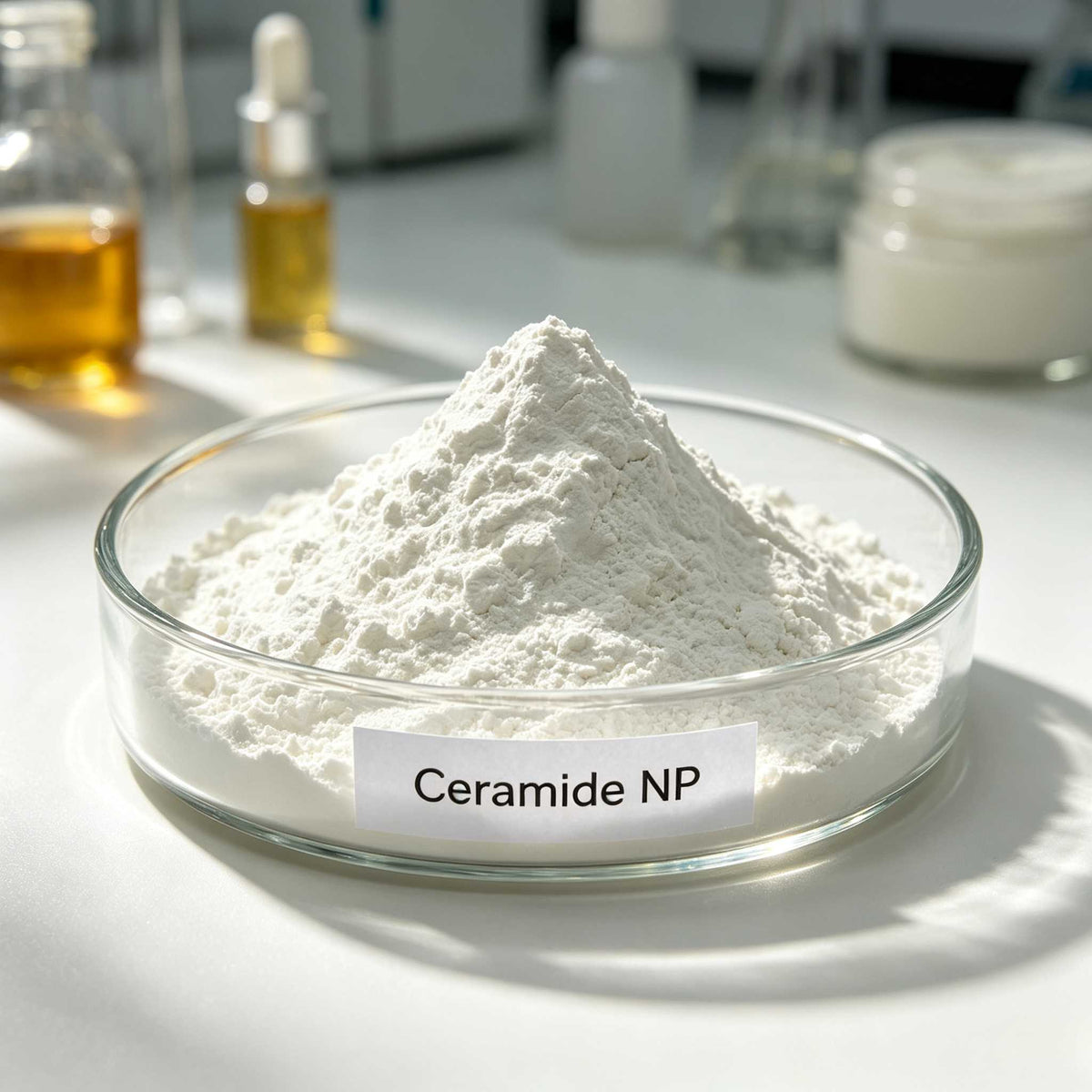
Formulate barrier-focused moisturizers, creams, balms and sensitive-skin products with Ceramide NP 95%, a concentrated cosmetic lipid supplied as a powder for measured formulation. Ceramide NP belongs to the ceramide family found in the stratum corneum and is widely selected when a formula needs a more skin-lipid-focused approach to moisture retention and barrier support [R2, R5].
- 95% Ceramide NP powder for controlled cosmetic formulation.
- Supports barrier-focused, moisture-retention and dry-skin product concepts [R2, R5].
- Best suited to carefully processed lipid/emulsion systems where the ceramide can be fully dissolved [R3–R4, R6].
Product Specifications
|
Specification |
Product Information |
|
Product name |
Ceramide NP |
|
INCI |
Ceramide NP |
|
Purity / Assay |
95% |
|
Commercial form |
Powder |
|
Ingredient family |
Ceramide / skin-barrier lipid |
|
Intended use |
Cosmetic raw material for measured formulation |
Key Benefits
Barrier-Focused Formulation Value. Ceramides are core lipids in the stratum corneum, where they contribute to the organized lipid matrix that helps control water loss and protect the skin surface. Ceramide-containing formulations are therefore widely used in barrier-support and moisturization concepts [R5–R6].
Supports Moisture Retention. A well-designed ceramide-containing moisturizer can support hydration and the skin’s water-retention function. [R5].
Useful for Dry & Sensitive-Skin Concepts. Ceramide NP is commonly selected for products positioned around dry-feeling, stressed or sensitive-looking skin, where a skin-lipid-centered formula architecture is commercially and technically relevant [R2].
Low-Dose Premium Lipid Active. High-purity Ceramide NP is used at comparatively low percentages, allowing formulators to build a technically differentiated barrier-lipid system without making the ceramide the dominant bulk phase [R3–R4].
Why Formulators Choose Ceramide NP
Ceramide NP gives formulators a defined ceramide ingredient rather than relying only on occlusive oils or general emollients. It is particularly useful when the formula brief calls for a “skin-lipid” approach: ceramide plus complementary lipids, humectants and soothing ingredients. The main challenge is processing. Ceramides are highly lipophilic and can crystallize or remain incompletely dispersed if they are not properly incorporated. A 2024 formulation review specifically emphasizes that correct dissolution and processing are essential to obtain the intended barrier-support function [R6].
Typical Applications
- Barrier creams & moisturizers: Daily moisturizers for dry-feeling or barrier-focused skin concepts
- Rich balms & night creams: Lipid-rich formulas where warm oil-phase processing is practical
- Sensitive-skin emulsions: Low-irritancy concepts that combine barrier lipids with soothing/hydrating ingredients
- Age-support skincare: Moisturization and skin-comfort positioning for mature/dry skin
- Body lotions & hand creams: Barrier and moisture-retention positioning for frequently washed or dry-feeling skin
Quick Formulation Guide
|
Parameter |
Typical Guidance |
|
Use level |
0.05–0.5% for comparable high-purity Ceramide NP grades [R3–R4] |
|
Phase |
Oil / lipid phase [R3–R4] |
|
Processing |
use >80°C to about 90°C [R3–R4] |
|
Finished pH |
pH 5.0–5.5 [R3] |
|
Compatibility strategy |
Use compatible emollients/emulsifiers and consider cholesterol + fatty-acid/lipid partners for skin-barrier-style lipid architecture [R5–R6] |
|
Validation |
Check clarity/dispersion, recrystallization, viscosity, emulsion stability and finished-product safety after cooling and during stability testing. |
Why Source From Us
- Start with samples scale to bulk orders – one supplier from trial to production: Validate with lab samples, then scale to commercial volumes – same quality, same team. No re-qualification, no project delays.
- Formulation support that actually helps – not just a data sheet: We give you hands-on guidance on solubility, temperature, pH, and compatibility. A real formulation partner, not a catalog.
- Reliable supply chain – consistent quality, on-time delivery, batch after batch: Own manufacturing facilities plus long-term partnerships with audited upstream producers ensure batch-to-batch consistency. Full documentation with every shipment. No "sample passes, bulk fails"
- Export-ready documentation – compliance, customs, cleared:Complete technical documentation packages – COA, MSDS, TDS, stability data – batch-specific and regulatory-ready. We handle the paperwork so your compliance and procurement teams can focus on formulation
Recommended Ingredient Pairings
|
Recommended Ingredient |
Why It Pairs Well |
Product Concept |
|
One of the major stratum-corneum lipid classes used with ceramides in barrier-lipid systems [R5–R6]. |
Barrier cream / rich moisturizer |
|
|
Fatty-acid / lipid partner |
Free fatty acids are another major lipid class in skin-barrier architecture [R5–R6]. |
Skin-lipid moisturizer |
|
Ceramide-related sphingoid lipid used in advanced barrier-lipid blends. |
Sensitive-skin barrier cream |
|
|
Adds humectant/conditioning and soothing-oriented formula value without duplicating Ceramide NP’s lipid role. |
Daily recovery moisturizer |
|
|
Adds water-binding/hydration positioning while Ceramide NP supports the lipid-barrier side of the formula. |
Hydrating barrier serum-cream |
Research & References
[R1] PubChem — Ceramide NP, CID 57378373
[R2] Evonik — Ceramide III (INCI Ceramide NP)
[R3] Evonik — Face & Body Cream F 11/10-5
[R4] Anallerg — Ceramide NP 95%
[R5] Clinical significance of ceramide-containing formulations — qualitative review (2021)
[R6] The role of ceramides in skin barrier function and correct formulation (2024)
Request a Quote
Tell us your required quantity, destination country, and any documentation needs. We usually reply within 1 business day.