

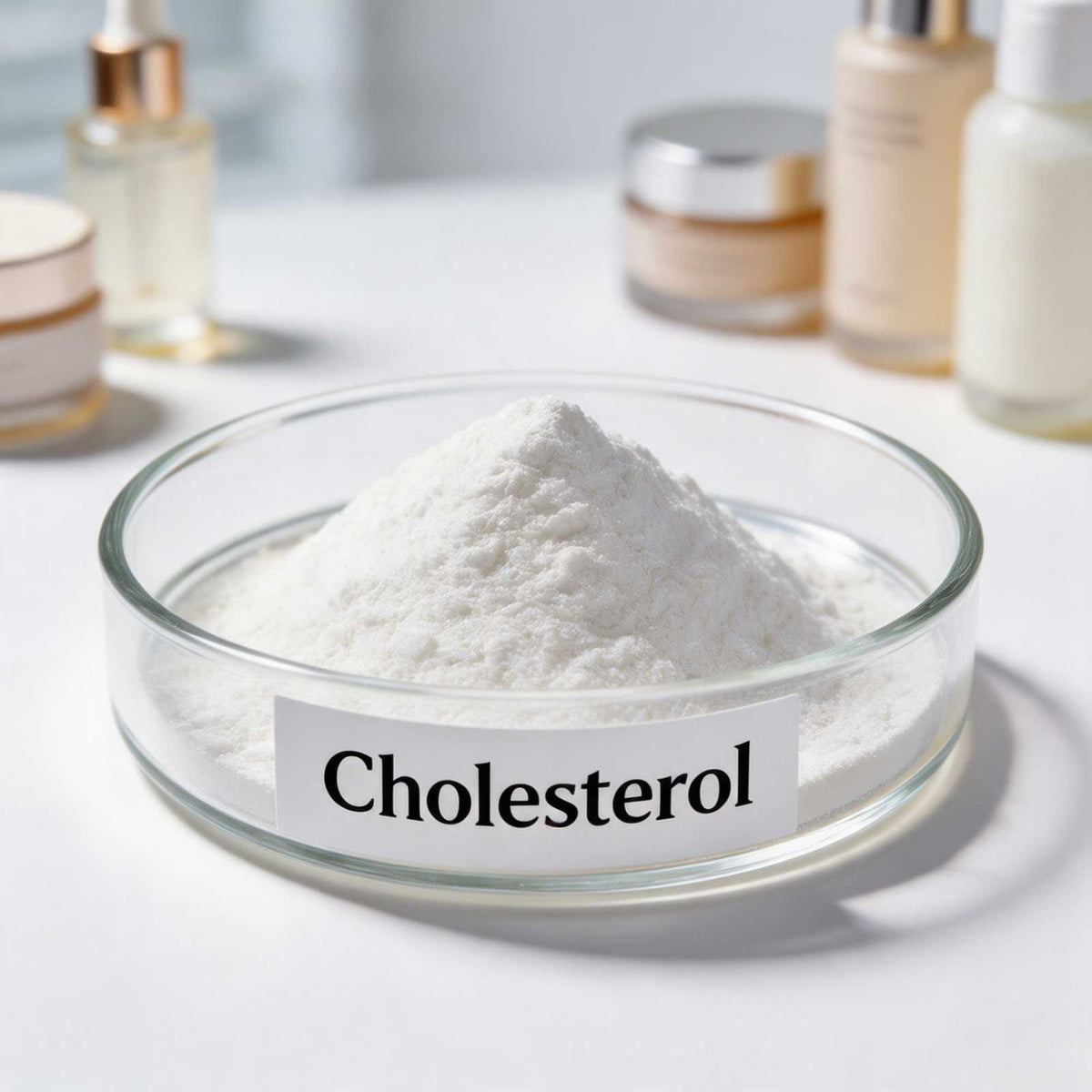
A high-purity skin-identical lipid for barrier-focused skincare, emollient systems and advanced cosmetic emulsions. Cholesterol is naturally present among the intercellular lipids of the stratum corneum and is commonly formulated alongside ceramides and fatty acids when developers want to build moisturizers, balms and lipid systems that support skin comfort, water retention and a resilient-feeling barrier. This 99% white powder is designed for measured cosmetic formulation, laboratory evaluation and commercial-scale sourcing.
- Skin-identical sterol for barrier-focused cosmetic formulations.
- Supports emolliency, moisture retention and a smoother skin feel.
- Especially relevant in ceramide + fatty-acid lipid systems.
- Oil-soluble powder suited to creams, lotions, balms and conditioning products.
- Practical small-pack testing with a bulk-supply path.
Product Specifications
|
Property |
Product information |
|
Product name |
Cholesterol |
|
INCI |
Cholesterol |
|
Commercial form |
White powder |
|
Assay |
≥99% |
|
CAS No. |
57-88-5 [R1] |
|
Molecular formula |
C27H46O [R1] |
|
Molecular weight |
Approx. 386.65 g/mol [R1] |
|
Ingredient family |
Sterol / skin-identical lipid |
Key Benefits
Supports barrier-lipid formulation concepts: Cholesterol is one of the key lipid classes found between stratum-corneum cells, together with ceramides and free fatty acids. This makes it especially useful in moisturizers and lipid systems designed around barrier support and skin comfort. [R5]Helps improve emolliency and moisture retention: As an oil-phase sterol, Cholesterol can contribute to a richer, more protective skin feel and help formulations reduce the dry, stripped sensory profile associated with lipid-deficient skin.
Complements ceramides and fatty acids: Barrier-lipid research shows that complete mixtures containing ceramides, cholesterol and fatty acids can support barrier recovery more effectively than incomplete lipid mixtures in tested systems. [R6] This makes Cholesterol particularly relevant in multi-lipid formulation strategies rather than as a standalone hero ingredient.
Useful beyond facial skincare: Cholesterol also fits body creams, balms and conditioning hair-care products where emolliency, lipid structure and moisture retention are formulation priorities. [R4]
Why Formulators Choose Cholesterol
Cholesterol provides more than generic oil-phase emolliency: it gives formulators a recognizable physiological lipid that can help organize a barrier-focused product concept alongside ceramides and suitable fatty acids. It can also support emulsion structure and conditioning performance. Because the effective level depends heavily on the lipid system and product format, Cholesterol is best developed as part of a complete formulation rather than treated as a universal single-active solution.
Typical Applications
- Barrier cream / moisturizer--Ceramide + cholesterol + fatty-acid lipid systems for dry-feeling or barrier-focused skincare
- Rich lotion / body cream--Emollient and moisture-retention concepts for dry skin
- Balm / ointment-style cosmetic--High-lipid comfort and protective sensory profiles
- Eye / targeted dry-area cream--Low-level skin-identical lipid support in rich emulsions
- Hair conditioner / treatment--Lipid-conditioning concepts for dry or damaged-feeling hair
- Lipid serum / lamellar emulsion--Advanced multi-lipid development with controlled solubilization and phase design
Quick Formulation Guide
|
Parameter |
Typical formulation guidance |
|
Use level |
About 0.1–0.5%. [R2–R4] |
|
Solubility / phase |
Oil-soluble; normally incorporate into the oil phase. [R4] |
|
Processing |
Use sufficient oil-phase heat and mixing to achieve uniform incorporation, then validate cooling behavior and recrystallization risk in the complete formula. |
|
Pairing strategy |
Often evaluated with ceramides and free fatty acids in barrier-lipid systems rather than as a single isolated lipid. [R5–R6] |
|
Compatibility |
Check emulsifiers, ceramides, fatty alcohols, fatty acids, antioxidants and packaging for physical stability and long-term crystallization behavior. |
|
Final validation |
Confirm emulsion integrity, viscosity, crystallization, odor/color stability, preservation and finished-product sensory performance. |
Why Source From Us
- Start with samples scale to bulk orders – one supplier from trial to production: Validate with lab samples, then scale to commercial volumes – same quality, same team. No re-qualification, no project delays.
- Formulation support that actually helps – not just a data sheet: We give you hands-on guidance on solubility, temperature, pH, and compatibility. A real formulation partner, not a catalog.
- Reliable supply chain – consistent quality, on-time delivery, batch after batch: Own manufacturing facilities plus long-term partnerships with audited upstream producers ensure batch-to-batch consistency. Full documentation with every shipment. No "sample passes, bulk fails"
- Export-ready documentation – compliance, customs, cleared:Complete technical documentation packages – COA, MSDS, TDS, stability data – batch-specific and regulatory-ready. We handle the paperwork so your compliance and procurement teams can focus on formulation
Scientific & Safety Snapshot
Cholesterol is a defined sterol with molecular formula C27H46O and CAS 57-88-5. [R1] The Expert Panel for Cosmetic Ingredient Safety concluded that Cholesterol is safe as a cosmetic ingredient in the practices of use and concentrations described in its safety assessment and 2025 re-review summary. [R2–R3] Current skin-barrier literature also recognizes cholesterol, ceramides and free fatty acids as major intercellular lipid classes that contribute to lamellar organization of the stratum corneum. [R5]
Recommended Ingredient Pairings
|
Recommended Ingredient |
Why It Pairs Well |
Product Concept |
Compatibility Note |
|
Ceramide NP |
Adds a complementary physiological barrier lipid |
Barrier-focused moisturizer |
Optimize lipid ratio, dispersion and emulsifier system; do not assume a universal ratio. |
|
Linoleic Acid / suitable free fatty acids |
Completes a three-lipid barrier concept with cholesterol and ceramides |
Lamellar lipid cream |
Validate oxidation stability and final lipid balance. |
|
Adds lightweight emolliency and improves oil-phase sensoriality |
Barrier serum or moisturizer |
Does not replace the structural role of ceramides/fatty acids. |
|
|
Tocopherol |
Provides antioxidant support in lipid-rich systems |
Barrier balm or lipid serum |
Validate total oil-phase oxidation stability and packaging. |
Research & References
[R1] PubChem — Cholesterol, CID 5997.
[R2] Cosmetic Ingredient Review — Cholesterol.
[R3] Raj P, et al. Re-Review Summary of Cholesterol as Used in Cosmetics. Int J Toxicol. 2025.
[R4] MakingCosmetics — Cholesterol NF specification sheet, updated 2025.
[R6] Exogenous lipids influence permeability barrier recovery in acetone-treated murine skin.
Request a Quote
Tell us your required quantity, destination country, and any documentation needs. We usually reply within 1 business day.