

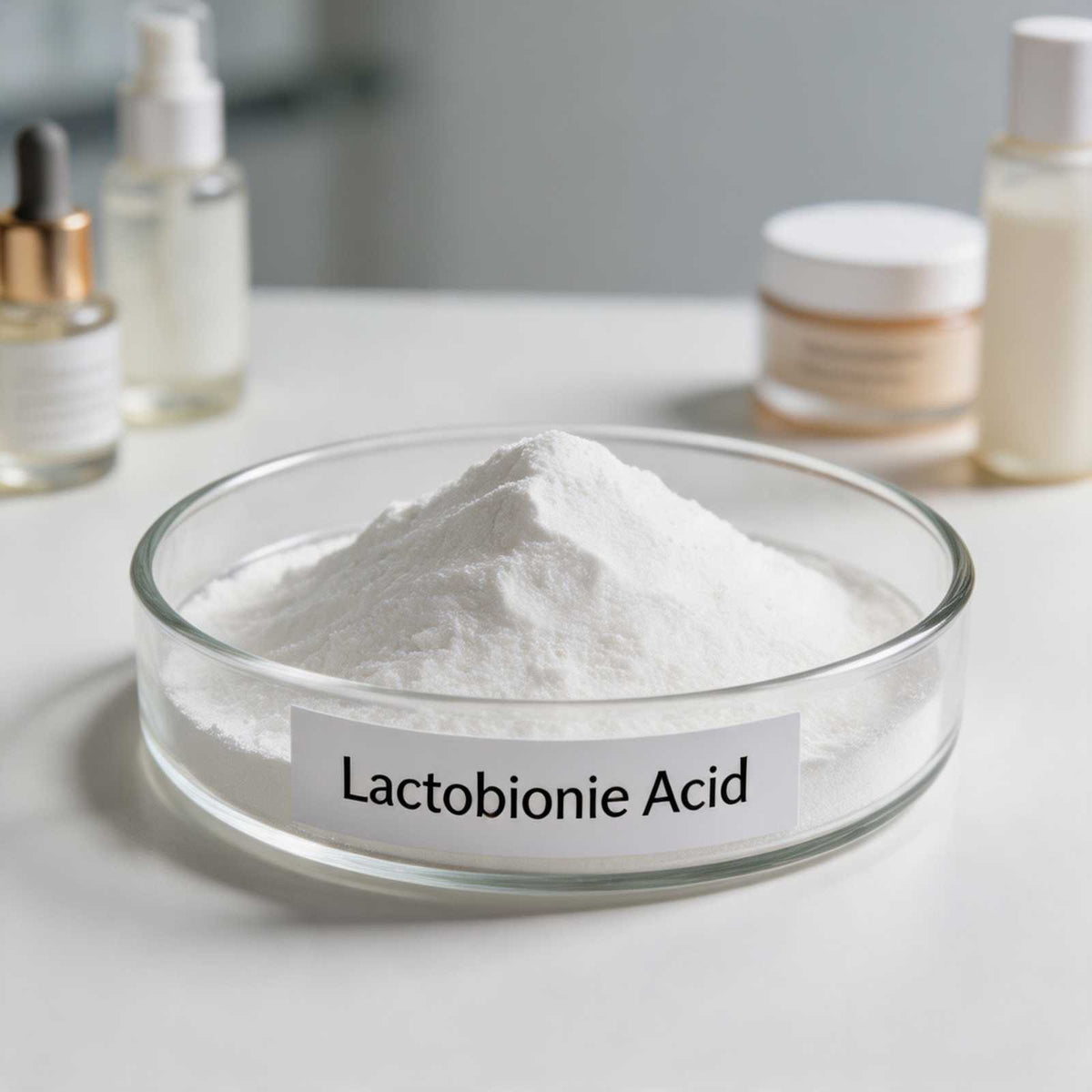
A high-purity polyhydroxy acid (PHA) for gentle exfoliation, hydration-support and skin-conditioning cosmetic formulas. Lactobionic Acid is a larger, highly hydroxylated acid commonly selected for sensitive-skin, barrier-conscious and daily-renewal concepts where formulators want smoother-looking texture and radiance without building the product around a more aggressive acid story. This 99% white powder is suited to measured R&D, small-batch development and commercial-scale sourcing.
- Supports gentle exfoliation and smoother-looking skin texture.
- Helps build hydrating, comfort-focused PHA formulas.
- Useful for radiance and more even-looking tone concepts.
- Water-soluble powder for toners, serums, gels and emulsions.
- Practical small-pack testing with a bulk-supply path.
Product Specifications
|
Property |
Product information |
|
Product name |
Lactobionic Acid |
|
INCI |
Lactobionic Acid |
|
Commercial form |
White powder |
|
Assay |
≥99% |
|
CAS No. |
96-82-2 [R1] |
|
Molecular formula |
C12H22O12 [R1] |
|
Molecular weight |
358.30 g/mol [R1] |
|
Ingredient family |
Polyhydroxy acid (PHA) / bionic acid |
Key Benefits
Gentle exfoliation for smoother-looking texture Lactobionic Acid is used in PHA-focused formulations designed to refine the appearance and feel of rough or dull-looking skin. Its cosmetic positioning is especially useful when a formula needs an exfoliation story with a gentler, hydration-conscious profile.Supports hydration-focused formulas Its multiple hydroxyl groups give Lactobionic Acid strong water-binding character, making it a useful choice in serums, essences and creams that combine renewal with moisturization and skin comfort.
Supports brighter, more radiant-looking skin By combining mild surface-renewal positioning with skin conditioning, Lactobionic Acid fits products designed to improve the look of dullness and uneven texture while maintaining a more comfortable user experience.
Useful for sensitive-skin and barrier-conscious concepts A published study of a 10% Lactobionic Acid emulsion reported reduced skin-surface pH without irritation or barrier impairment in the tested system, supporting interest in Lactobionic Acid for carefully formulated acidifying and sensitive-skin concepts. [R2]
Why Formulators Choose Lactobionic Acid
Lactobionic Acid combines several development roles in one ingredient: PHA exfoliation, humectant-style water binding, skin conditioning and antioxidant-oriented positioning. It is water-soluble, so it integrates naturally into many aqueous product formats, while its premium PHA identity can help differentiate gentle-renewal serums, toners, moisturizers and masks from conventional AHA-only formulas. [R3–R4]
Typical Applications
PHA toner / essence--Daily or periodic gentle-renewal concepts with hydration supportSerum / gel--Texture, radiance and sensitive-skin-focused active products
Cream / lotion--Barrier-conscious moisturizers with mild resurfacing positioning
Hydrating mask--Moisture-focused treatment formats with a PHA angle
Eye-area / delicate-skin concept--Low-level evaluation where gentleness and hydration are prioritized
Post-stress / mature-skin care--Conditioning formulas focused on comfort, smoothness and radiance
Why Source From Us
- Start with samples scale to bulk orders – one supplier from trial to production: Validate with lab samples, then scale to commercial volumes – same quality, same team. No re-qualification, no project delays.
- Formulation support that actually helps – not just a data sheet: We give you hands-on guidance on solubility, temperature, pH, and compatibility. A real formulation partner, not a catalog.
- Reliable supply chain – consistent quality, on-time delivery, batch after batch: Own manufacturing facilities plus long-term partnerships with audited upstream producers ensure batch-to-batch consistency. Full documentation with every shipment. No "sample passes, bulk fails"
- Export-ready documentation – compliance, customs, cleared:Complete technical documentation packages – COA, MSDS, TDS, stability data – batch-specific and regulatory-ready. We handle the paperwork so your compliance and procurement teams can focus on formulation
Recommended Ingredient Pairings
|
Recommended Ingredient |
Why It Pairs Well |
Product Concept |
Compatibility Note |
|
Adds hydration and cushioning skin feel |
Hydrating PHA serum |
Hydrate polymer correctly and re-check viscosity after pH adjustment. |
|
|
Adds humectant and conditioning support |
Sensitive-skin PHA toner |
Validate final pH and preservation. |
|
|
Complements comfort-focused product positioning |
Gentle renewal cream or mask |
Check solubility and crystallization risk. |
|
|
Fits brightening, hydration and barrier-conscious concepts |
Multi-active radiance serum |
Validate pH, stability and complete-formula compatibility. |
Scientific Evidence Snapshot
Lactobionic Acid is a defined sugar acid with the molecular formula C12H22O12 and CAS 96-82-2. [R1] In a published 2019 study, a moisturizer containing 10% Lactobionic Acid reduced skin-surface pH without measurable irritation or barrier impairment in the tested formulation and study conditions. [R2] This supports formulation interest in Lactobionic Acid as a PHA for acidifying.
Research & References
[R1] PubChem — Lactobionic Acid, CID 7314.
[R3] Unifect / SpecChem — SpecKare LBA Lactobionic Acid.
Request a Quote
Tell us your required quantity, destination country, and any documentation needs. We usually reply within 1 business day.