

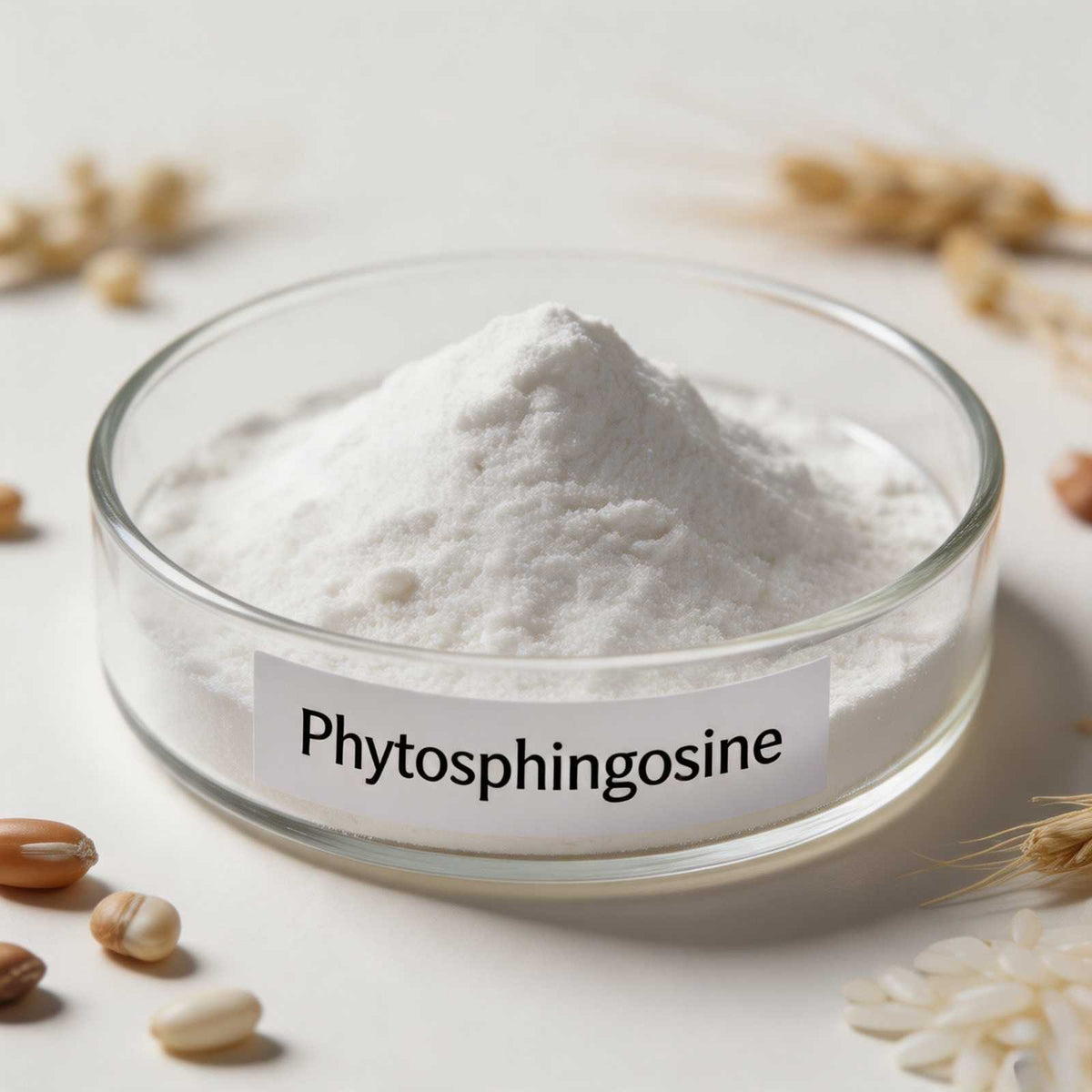
A high-purity, skin-identical sphingoid base for cosmetic formulas focused on skin comfort, hydration, barrier-support positioning and the appearance of blemish-prone skin. Phytosphingosine occurs naturally within the stratum corneum and is also a building block of important phytoceramides. This 98% white powder is intended for measured formulation work, from small-scale R&D through commercial development—not direct raw-material application.
- Supports formulas designed for calmer-looking skin and a more balanced-looking blemish-prone complexion.
- Adds a skin-lipid / sphingolipid story to barrier-support and moisturization concepts.
- Useful in face care, targeted serums, creams, lotions and selected scalp or body-care concepts.
- Available in practical paid trial sizes for evaluation, with a bulk inquiry path for scale-up.
Product Specifications / Key Facts
|
Product |
Phytosphingosine Powder 99% |
|
INCI |
Phytosphingosine [R3] |
|
CAS Number |
554-62-1 [R1] |
|
Molecular Formula |
C18H39NO3 [R1] |
|
Molecular Weight |
317.51 g/mol [R1] |
|
Assay |
98% |
|
Ingredient Family |
Sphingoid base / skin-lipid active |
Key Benefits
Helps support calmer-looking skin: Phytosphingosine is used in cosmetic systems for skin-comfort positioning and to help improve the appearance of redness and blemish-prone skin. [R3]
Supports hydration and natural moisturizing factor pathways: Human and laboratory research links phytosphingosine with filaggrin-related processes and natural moisturizing factor formation, supporting its use in hydration-focused skin-care concepts. [R5]
Fits barrier-support and skin-lipid formulations: As a skin-identical sphingoid base and a structural building block related to phytoceramides, it is well suited to formulations built around the skin’s lipid architecture. [R7]
Useful at low active levels: Commercial phytosphingosine products are positioned as low-use actives, making precise weighing, premixing and grade-specific incorporation important during R&D and scale-up. [R3–R4]
Why Formulators Choose Phytosphingosine
- It brings a skin-identical sphingolipid story to formulas without requiring a complex multi-ceramide blend.
- Its benefits span several closely related cosmetic needs: skin comfort, moisture support, lipid-barrier positioning and blemish-prone-skin care.
- The 98% powder format gives R&D teams direct control over active-basis dosing instead of relying on a fixed pre-diluted blend.
- It can be combined with humectants, soothing actives, antioxidants and lipid-phase ingredients to build a more complete skin-comfort system.
Typical Applications
- Face serums: Low-dose skin-comfort, hydration or blemish-prone-skin concepts.
- Creams & lotions: Barrier-support, dry-skin-comfort and daily moisturizer positioning.
- Targeted blemish-care products: Cosmetic formulas focused on the appearance of redness, visible blemishes and skin balance.
- Sensitive-skin concepts: Multi-active systems centered on comfort, moisturization and a supported skin barrier.
- Scalp / body care: Selected comfort or microbiome-balance concepts when formulation and market requirements support the use.
Quick Formulation Guide
|
Formulation Question |
Buyer Guidance |
|
Recommended Dosage |
0.5% – 5.0% |
|
Is it water soluble? |
No, it is oil soluble [R4, R8] |
|
How should I incorporate it? |
Prepare a controlled premix or stock appropriate to the selected grade, then add it at a process stage that protects uniform dispersion and avoids local over-concentration. |
|
Does pH matter? |
Yes. Phytosphingosine contains a basic amine, so acid system and final pH can influence ionic state and solubilization. pH 5.0 - 7.0 |
|
What should I validate? |
Check clarity/dispersion, pH, viscosity, preservation, compatibility with emulsifiers and other actives, color/odor stability, and finished-product stability before scale-up. |
Why Source From Us
- Start with samples scale to bulk orders – one supplier from trial to production: Validate with lab samples, then scale to commercial volumes – same quality, same team. No re-qualification, no project delays.
- Formulation support that actually helps – not just a data sheet: We give you hands-on guidance on solubility, temperature, pH, and compatibility. A real formulation partner, not a catalog.
- Reliable supply chain – consistent quality, on-time delivery, batch after batch: Own manufacturing facilities plus long-term partnerships with audited upstream producers ensure batch-to-batch consistency. Full documentation with every shipment. No "sample passes, bulk fails"
- Export-ready documentation – compliance, customs, cleared:Complete technical documentation packages – COA, MSDS, TDS, stability data – batch-specific and regulatory-ready. We handle the paperwork so your compliance and procurement teams can focus on formulation
Recommended Ingredient Pairings
|
Recommended Ingredient |
Why It Pairs Well |
Product Concept |
Compatibility Note |
|
Adds a phospholipid/emulsification tool that can support lipid-active delivery and structured emulsions. |
Skin-lipid barrier serum or cream |
Optimize emulsifier system and avoid assuming lecithin alone guarantees solubilization. |
|
|
Adds hydration and skin-comfort support to a sphingolipid-focused formula. |
Sensitive-skin comfort serum |
Validate pH, electrolyte load and preservation. |
|
|
Adds water-binding hydration to complement lipid-barrier positioning. |
Hydrating barrier-support serum |
Check viscosity, electrolyte sensitivity and final feel. |
|
|
Adds a soothing/comfort angle for formulas targeting visible redness and sensitive-feeling skin. |
Calming moisturizer or serum |
Confirm solubility and keep finished-product claims cosmetic. |
|
|
Adds antioxidant positioning to daily skin-defense concepts. |
Antioxidant + skin-lipid serum |
Verify antioxidant system, packaging and long-term color stability. |
Scientific Evidence Snapshot
Phytosphingosine is a sphingoid base naturally present in the stratum corneum and closely connected to skin ceramide biology. [R3, R7] A 2017 study reported that phytosphingosine increased markers involved in keratinocyte differentiation and filaggrin metabolism, with higher pyrrolidone carboxylic acid and skin hydration observed in the human study arm. [R5] Separate research has described antimicrobial and inflammatory-response effects relevant to blemish-prone skin, while another study found that phytosphingosine increased phytoceramide pools in keratinocyte work. [R6, R9] These findings support cosmetic hydration, skin-comfort and lipid-barrier product concepts.
Research & References
[R1] PubChem — Phytosphingosine, CID 122121
[R3] Evonik — Phytosphingosine
[R5] Choi et al. — Phytosphingosine enhances moisture level in human skin barrier…
[R6] Pavicic et al. — Anti-microbial and -inflammatory activity and efficacy of phytosphingosine…
[R7] Evonik — Ceramides and Sphingolipids
[R9] Sigruener et al. — Effects of sphingoid bases on the sphingolipidome…
Request a Quote
Tell us your required quantity, destination country, and any documentation needs. We usually reply within 1 business day.