

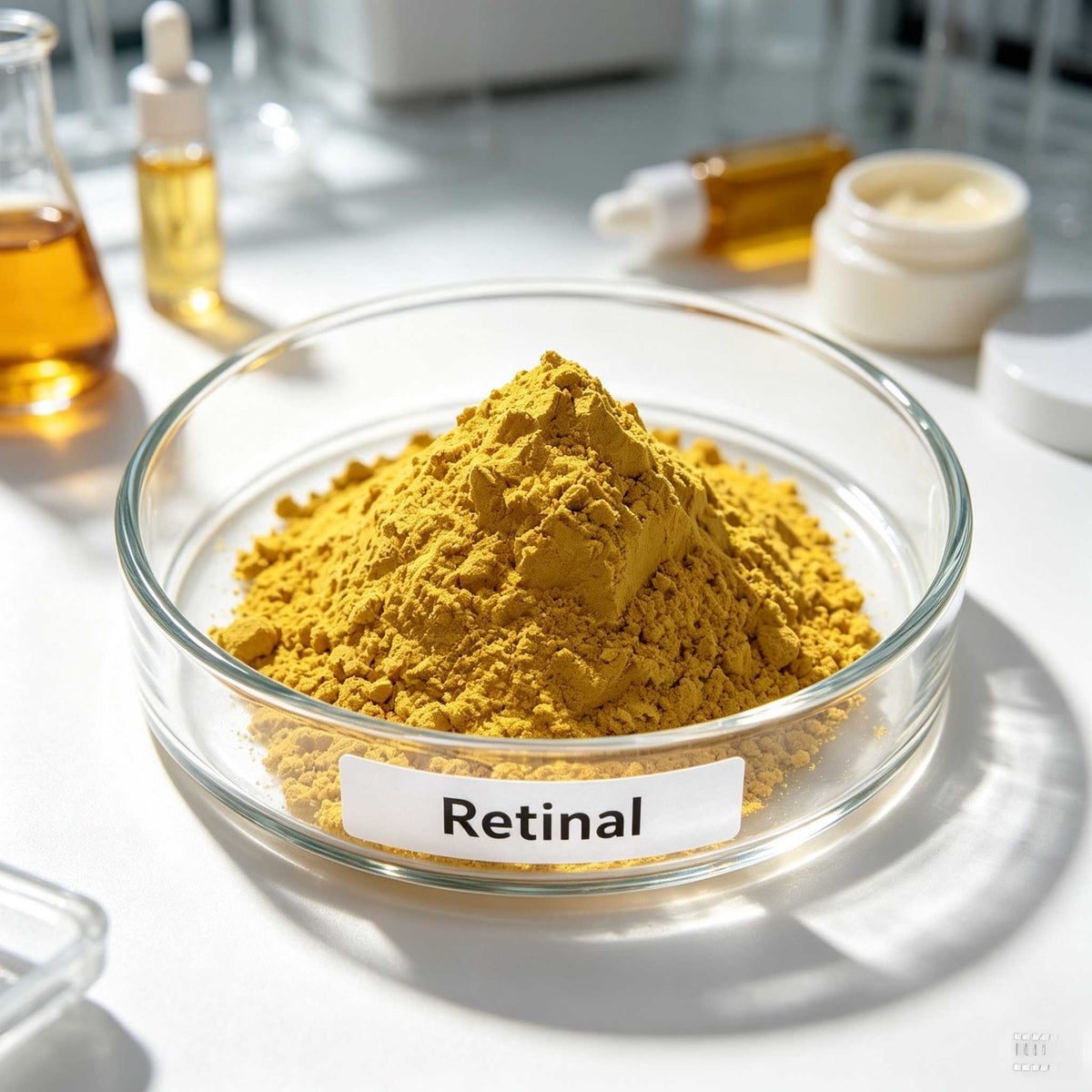
A high-purity retinaldehyde raw material for advanced anti-aging cosmetic formulation.
Retinal—also called retinaldehyde—is the aldehyde form of vitamin A and a direct precursor to retinoic acid. This 99% powder is intended for controlled R&D in premium night serums, creams and delivery systems where fine lines, texture, elasticity and tone are key goals. [R3–R6]
- 99% Retinal / Retinaldehyde powder for measured cosmetic formulation.
- supports wrinkle-, texture-, hydration- and elasticity-focused age-support concepts. [R3–R5]
- Distinct from retinol: retinal is one biochemical conversion step from retinoic acid.
Product Specifications / Key Facts
|
Property |
Product Information |
|
Product Name |
Retinal / Retinaldehyde |
|
Commercial Form |
Powder |
|
Purity / Assay |
99% |
|
INCI |
RETINAL [R2] |
|
CAS Number |
116-31-4 [R1–R2] |
|
Molecular Formula / MW |
C20H28O / 284.4 g/mol [R1] |
|
Identity |
All-trans retinal / retinaldehyde |
|
Ingredient Family |
Vitamin A retinoid / retinoic-acid precursor |
Key Benefits
Fine lines and wrinkles — Finished retinaldehyde creams have shown improvements in wrinkle-related and photoaging parameters. [R3–R4]
Smoother-looking texture — A randomized study found significant texture improvements with 0.05% and 0.1% retinaldehyde creams. [R3]
Elasticity and skin quality — Human studies report improvements in elasticity, hydration and other aging-related biophysical measures. [R3–R5]
Even-looking tone — The 0.1% group in the 2018 study improved melanin index; the 0.05% group did not, so tone claims should remain formula-specific. [R3]
Typical Applications
- Night serums and age-support concentrates
- Fine-line and texture-focused facial creams
- Lipid-carrier or encapsulated retinal systems
- Eye-area and premium retinoid products with validated stability
Quick Formulation Guide
|
Parameter |
Typical Formulation Guidance |
|
Use Level |
about 0.01–0.10% [R3–R5] |
|
Solubility / Phase |
Retinal is lipophilic; pre-solubilize in a compatible solvent or lipid carrier[R8–R9] |
|
Processing |
Minimize heat and unnecessary exposure to strong light and air; cool-down or another low-temperature addition step is generally preferred when the system permits. [R6,R8] |
|
Compatibility |
Evaluate strong oxidizing/reducing systems, extreme pH, metal ions and other reactive ingredients through assay, color and odor stability testing. |
|
Packaging |
Opaque or UV-protective, low-air-exposure packaging is generally preferred for sensitive retinoid systems. [R6,R8] |
Why Source From Us
- Start with samples scale to bulk orders – one supplier from trial to production: Validate with lab samples, then scale to commercial volumes – same quality, same team. No re-qualification, no project delays.
- Formulation support that actually helps – not just a data sheet: We give you hands-on guidance on solubility, temperature, pH, and compatibility. A real formulation partner, not a catalog.
- Reliable supply chain – consistent quality, on-time delivery, batch after batch: Own manufacturing facilities plus long-term partnerships with audited upstream producers ensure batch-to-batch consistency. Full documentation with every shipment. No "sample passes, bulk fails"
- Export-ready documentation – compliance, customs, cleared:Complete technical documentation packages – COA, MSDS, TDS, stability data – batch-specific and regulatory-ready. We handle the paperwork so your compliance and procurement teams can focus on formulation
Recommended Ingredient Pairings
|
Ingredient |
Why It Pairs Well |
Product Concept |
Compatibility Note |
|
Barrier-lipid support |
Retinal night cream |
Use appropriate lipid/emulsion architecture; validate active stability. |
|
|
Barrier, hydration and tone-care support |
Night serum / cream |
Validate pH, color and long-term stability. |
|
|
Conditioning and comfort |
Comfort-focused retinal treatment |
Confirm preservation and full-formula stability. |
|
|
Hydration and slip |
Hydrating retinal serum |
Aqueous vs lipophilic phase architecture matters. |
|
|
Emollient oil-phase option |
Retinal facial oil / emulsion |
Verify retinal solubility and oxidation stability. |
|
|
Oil-phase antioxidant support |
Protected retinal oil phase |
Does not replace assay-based stability testing. |
Scientific Evidence Snapshot
Retinaldehyde has human topical evidence. A randomized double-blind study of 0.05% and 0.1% creams reported improved texture, hydration and TEWL, with melanin-index improvement only in the 0.1% group. [R3] A randomized split-face study of multilamellar-vesicle retinaldehyde reported improvements in wrinkle depth and aging-related biophysical parameters. [R4] Earlier human work also demonstrated biologic activity and topical tolerance. [R5]
Research & References
[R1] PubChem — Retinal (CID 638015)
[R2] European Commission CosIng — RETINAL, Ref 59127
[R3] Kwon HS et al. Retinaldehyde 0.1% and 0.05% creams in photoaged skin
[R4] Multilamellar-vesicle retinaldehyde randomized split-face study
[R5] Topical retinaldehyde on human skin: biologic effects and tolerance
[R6] 2024 topical-retinoid instability / carrier review
Request a Quote
Tell us your required quantity, destination country, and any documentation needs. We usually reply within 1 business day.