

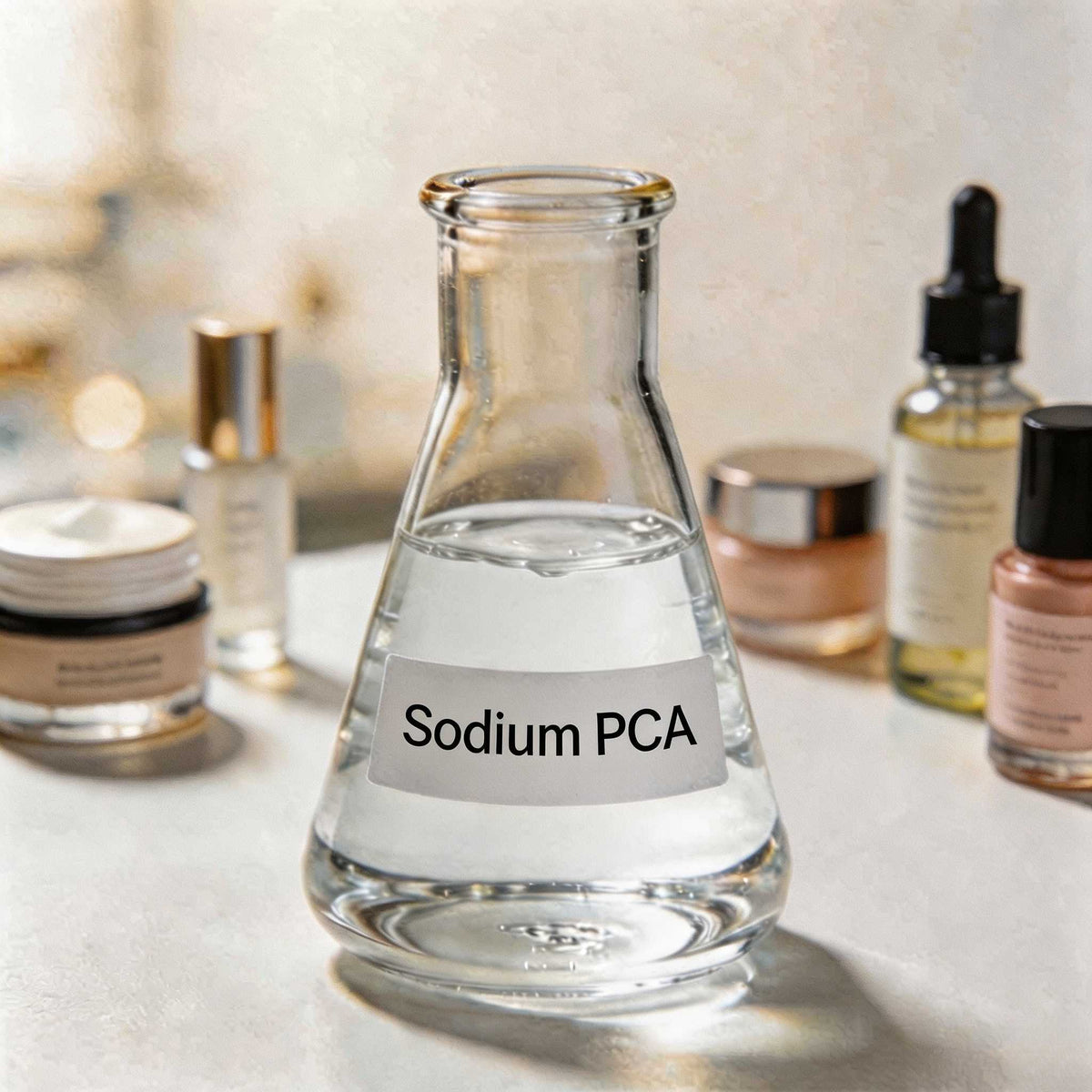
Develop hydrating skin-care and hair-care formulas with Sodium PCA, a water-soluble humectant associated with the skin's natural moisturizing factor. The working commercial grade is a colorless to pale yellow clear liquid containing approximately 50% Sodium PCA in water, offering easy weighing and water-phase incorporation without powder-dissolution steps.
Product Specifications
|
At a glance |
Details |
|
INCI |
Sodium PCA |
|
CAS |
28874-51-3 for Sodium 5-oxo-L-prolinate; water 7732-18-5 |
|
Formula / molecular weight |
C5H6NNaO3 / approximately 151.10 for Sodium PCA |
|
Appearance |
Colorless to pale yellow clear liquid |
|
Active concentration |
approximately 50% in water |
|
Solubility |
Water-soluble; not oil-soluble |
|
Typical first screen |
1-5%, equivalent to about 0.5-2.5% active at 50% concentration |
Why Formulators Choose Sodium PCA
- NMF-related humectancy: PCA is a major component measured in the stratum corneum's natural moisturizing factor [R6].
- Lightweight hydration support: useful in formulas designed for soft, supple and comfortably hydrated-feeling skin.
- Simple liquid handling: a 50% aqueous solution can be weighed directly into the water phase or suitable cool-down phase.
- Skin and hair versatility: fits toners, serums, lotions, cleansers, shampoos, conditioners and scalp-care concepts.
Best-Fit Applications
- Toners and essences: Adds humectancy in a light, water-based format.
- Serums and gels: Supports hydration without adding an oil phase.
- Creams and lotions: Complements emollients and occlusives with water-binding support.
- Cleansers: Adds a conditioning-oriented hydration story to rinse-off products.
- Shampoos and conditioners: Supports conditioned feel and static-control concepts.
Quick Formulation Guide
|
Variable |
Practical starting point |
|
Use level |
Leave-on (serums, creams, lotions): 1% – 5% |
|
Phase |
Water-soluble — add directly to the water phase. |
| PH | Stable across a broad pH range — optimal formulation pH 4.5 – 7.0 (ideally 5.0 – 6.0) . |
|
Electrolytes |
Treat Sodium PCA as an ionic input when selecting thickeners and surfactant systems. |
|
Preservation |
Count the water introduced by the raw material and preserve the complete finished formula. |
Recommended Pairings
|
Pairing |
Concept value |
Example direction |
|
Glycerin |
Combines two familiar humectants with different sensory contributions. |
Hydrating toner or body lotion. |
|
Adds osmolyte and conditioning support. |
Low-tack essence or shampoo. |
|
|
Adds polymeric hydration and slip. |
Layered-hydration serum. |
|
|
Adds humectant and conditioning support for skin or hair. |
Comfort-focused lotion or scalp serum. |
|
|
Builds an NMF-inspired hydration system. |
Hand, foot or body-care emulsion. |
References
[R1] ECHA — Sodium 5-oxo-L-prolinate Identity
[R2] PubChem — Sodium Pidolate
[R3] Cosmetic Ingredient Review — PCA and Sodium PCA Safety Assessment
[R4] CIR — Final Amended Safety Assessment Announcement
[R5] MakingCosmetics — Sodium PCA Fact Sheet
[R6] Kezic et al. — NMF Components in Stratum Corneum
[R7] Rawlings et al. — Pyrrolidone Carboxylic Acid and the Skin
Request a Quote
Tell us your required quantity, destination country, and any documentation needs. We usually reply within 1 business day.