

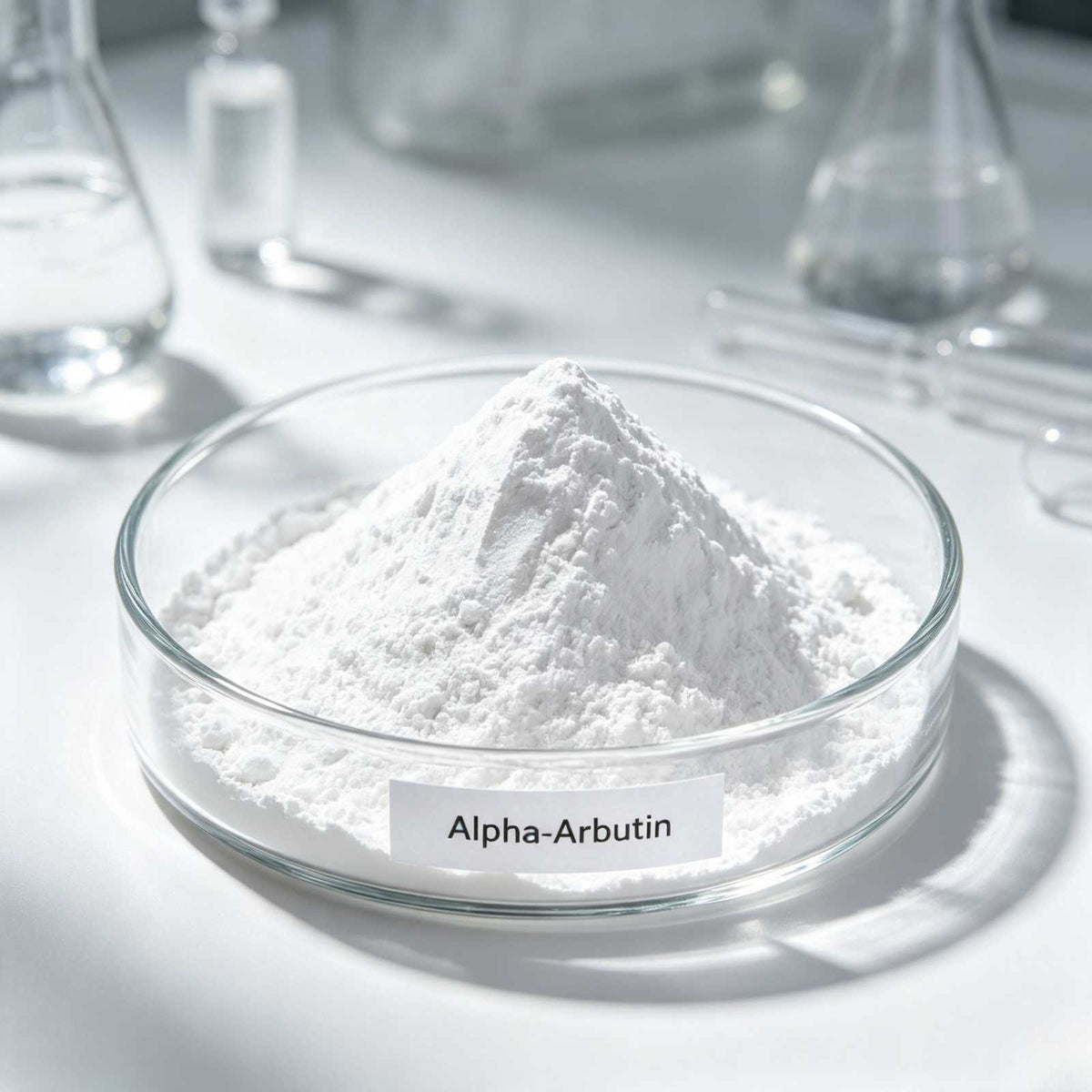
A water-soluble cosmetic active for formulators developing serums, creams, lotions and targeted tone-care products. Alpha-Arbutin supports a brighter, more even-looking complexion and helps reduce the visible appearance of dark spots while fitting practical bench-to-bulk development workflows.
- 99% Alpha-Arbutin powder for measured cosmetic formulation
- Supports brighter, more even-looking skin tone
- Water-phase active suited to serums, emulsions and masks
- 10 g to 500 g paid packs, with commercial quantities by inquiry
Product Specifications
|
Specification |
Product Information |
|
INCI Name |
Alpha-Arbutin |
|
Commercial Form |
Powder |
|
Assay / Purity |
99% |
|
CAS Number |
84380-01-8 [R1-R2] |
|
Molecular Formula |
C12H16O7 [R1] |
|
Formulation Role |
Cosmetic brightening and skin-conditioning active |
Key Benefits
Supports a more even-looking tone: A focused choice for formulas designed to improve the look of uneven tone and visible discoloration.
Helps reduce the appearance of dark spots: Suitable for targeted brightening products addressing the look of sun-related spots and localized unevenness.
Promotes a brighter, clearer-looking complexion: Fits daily-use tone-care concepts where gradual cosmetic improvement and a refined skin appearance are the goals.
Why Formulators Choose Alpha-Arbutin
Alpha-Arbutin is a defined, water-soluble active that can be incorporated into many aqueous and emulsion systems. Its focused role makes it useful in single-active prototypes and multi-active brightening concepts. The powder format also supports accurate scaling from trail size evaluation packs to pilot and commercial production.
Typical Applications
- Water-based brightening serums and essences
- Face creams and lightweight emulsions for more even-looking tone
- Targeted dark-spot and post-sun tone-care products
- Body lotions developed within the applicable regional use limits
- Hydrating masks, gels and concentrated booster formulas
Quick Formulation Guide
|
Formulation Field |
Typical Guidance |
|
Typical Use Level |
0.2-2% for comparable cosmetic grades [R6-R7]. For EU products, maximum ready-to-use concentrations are 2% in face cream and 0.5% in body lotion [R2]. |
|
Phase / Solubility |
water soluble [R6-R7]. |
|
pH Starting Point |
Start development around pH 5.0-6.5, then confirm assay and appearance through stability testing [R6-R7]. |
|
Processing |
Add during cool-down or otherwise keep the ingredient below 40°C [R6-R7]. |
|
Compatibility |
Check final pH and stability when combining multiple brightening actives, exfoliating acids, chelators or high-electrolyte systems. |
|
Packaging / Storage |
Keep the raw material tightly closed, dry and protected from light; select finished-product packaging through formula stability testing [R6-R7]. |
Confirm all guidance against the selected grade and validate the complete formula under its intended packaging, storage and market conditions.
Why Source From Us
- Start with samples scale to bulk orders – one supplier from trial to production: Validate with lab samples, then scale to commercial volumes – same quality, same team. No re-qualification, no project delays.
- Formulation support that actually helps – not just a data sheet: We give you hands-on guidance on solubility, temperature, pH, and compatibility. A real formulation partner, not a catalog.
- Reliable supply chain – consistent quality, on-time delivery, batch after batch: Own manufacturing facilities plus long-term partnerships with audited upstream producers ensure batch-to-batch consistency. Full documentation with every shipment. No "sample passes, bulk fails"
- Export-ready documentation – compliance, customs, cleared:Complete technical documentation packages – COA, MSDS, TDS, stability data – batch-specific and regulatory-ready. We handle the paperwork so your compliance and procurement teams can focus on formulation
Recommended Ingredient Pairings
|
Recommended Ingredient |
Why It Pairs Well |
Product Concept |
Compatibility Note |
|
Adds a complementary even-tone and barrier-support direction |
Daily brightening serum or lotion |
Align the formula pH and confirm color/odor stability |
|
|
Adds hydration and a plumper skin-feel profile |
Hydrating brightening serum or gel cream |
Disperse correctly and manage viscosity before final pH adjustment |
|
|
Adds conditioning and comfort-focused support |
Sensitive-skin-oriented tone-care emulsion |
Validate preservative efficacy and sensory profile in the complete system |
|
|
Builds a multi-active radiance concept with a water-soluble vitamin C derivative |
Brightening serum or light cream |
Select a shared pH window and run accelerated stability testing |
Scientific Evidence Snapshot
Laboratory research has reported that Alpha-Arbutin reduced melanin synthesis in cultured cells and a three-dimensional human skin model without reducing viability under the reported test conditions [R4]. Commercial ingredient literature also positions Alpha-Arbutin for more even-looking tone and reduced visible tanning after UV exposure [R5]. These findings support cosmetic formula development; finished-product performance still depends on concentration, vehicle, packaging, stability and use conditions.
Research & References
- [R1] PubChem - Alpha-Arbutin compound record
- [R2] Commission Regulation (EU) 2024/996
- [R4] Sugimoto et al. - Inhibitory effects of alpha-arbutin on melanin synthesis
- [R6] MakingCosmetics - Alpha-Arbutin formulation guidance
- [R7] Lotioncrafter - Alpha-Arbutin formulation guide
Request a Quote
Tell us your required quantity, destination country, and any documentation needs. We usually reply within 1 business day.