

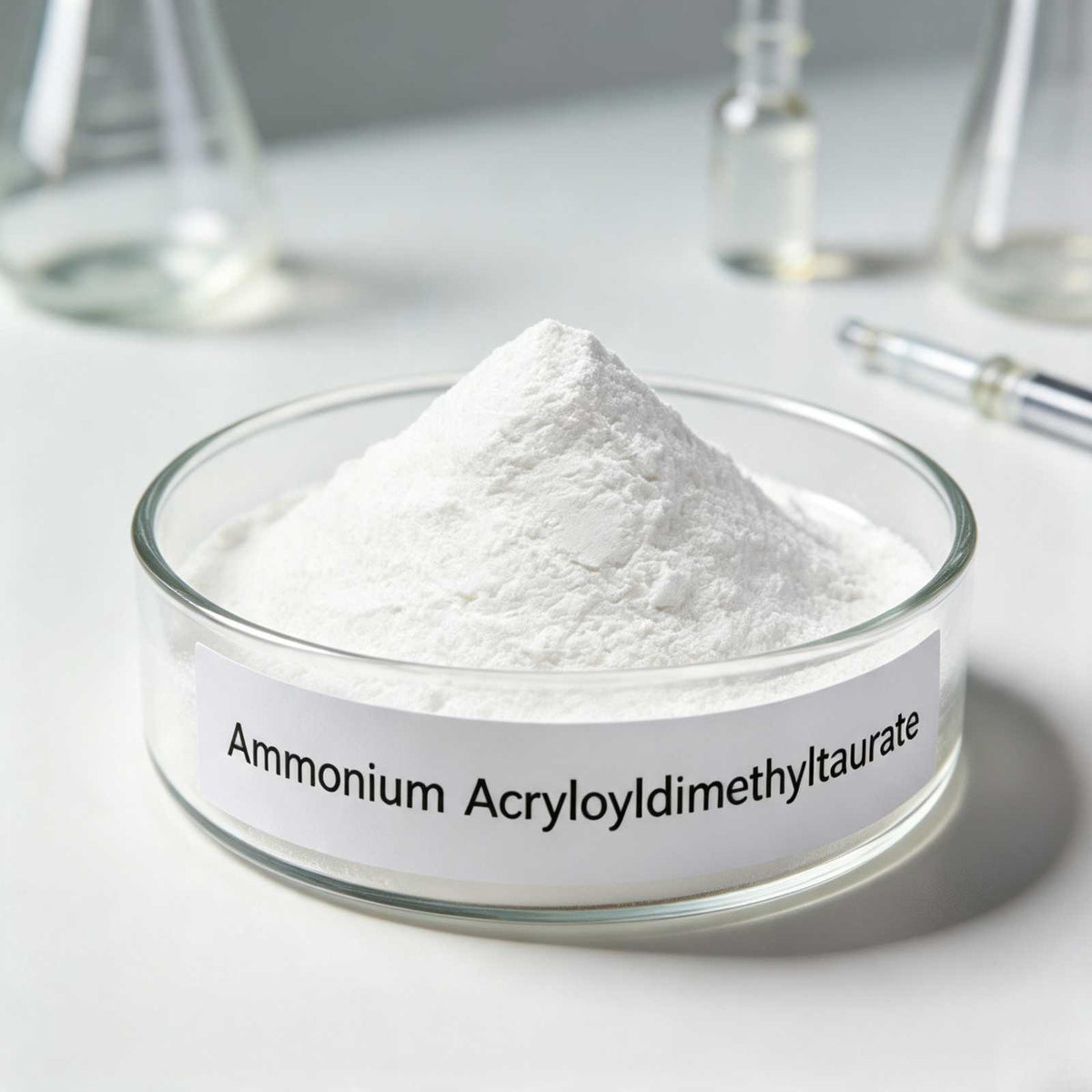
A high-efficiency, pre-neutralized rheology modifier for clear gels, lightweight gel-creams and oil-in-water emulsions. Ammonium Acryloyldimethyltaurate/VP Copolymer is widely valued for fast viscosity build, cold-process flexibility, stabilization and a fresh, low-tack skin feel.
- Builds clear to translucent gels and elegant gel-cream textures.
- Pre-neutralized polymer simplifies processing and supports cold manufacture.
- Helps stabilize O/W emulsions and improve suspension / yield value.
- Delivers a light, fresh, fast-breaking sensory profile in many leave-on systems.
- Available in practical trial sizes with a bulk RFQ path.
Product Specifications
|
Property |
Product information |
|
INCI |
Ammonium Acryloyldimethyltaurate/VP Copolymer |
|
Commercial form |
White powder |
|
Ingredient family |
Synthetic polymeric rheology modifier |
|
Primary functions |
Thickening, gelling, rheology modification, stabilization; emulsifying support in suitable O/W systems |
Key Benefits
Fast, efficient texture building: This polymer is selected for rapid viscosity development in aqueous systems and for creating lightweight gels and gel-creams with strong structure at relatively low use levels. [R1, R3]Cold-process convenience: Comparable grades are pre-neutralized and cold-processable, reducing process complexity and making the ingredient attractive for energy-efficient manufacturing and heat-sensitive formula concepts. [R1, R3]
Fresh, elegant sensory: The polymer is known for a light, fresh and fast-breaking feel, helping formulators move away from heavy or tacky gel textures in facial and body-care products. [R1]
Stabilization and suspension support: Its rheology profile can improve yield value and help stabilize dispersed phases in appropriately designed systems, including many O/W emulsions and gel-creams. [R1, R3]
Flexible across modern leave-on formats: places the polymer in creams, lotions, sun-care and color-cosmetic applications, also support clear aqueous gels and emulsifier-light gel-creams. [R1, R3]
Why Formulators Choose This Polymer
It is particularly useful when formulators want elegant texture without a separate neutralization step, while still retaining strong control over flow, suspension and sensory. The key advantage is not simply “more viscosity.” This polymer can help shape flow, break, cushion and stability at the same time. Because it arrives pre-neutralized, it can shorten development steps compared with traditional carbomer-style systems that require neutralization. It is particularly attractive for modern serum-gels, gel moisturizers and fluid emulsions where a clean, non-stringy sensory profile matters. The main formulation trade-off is electrolyte sensitivity: salts, some botanical/protein solutions and highly ionic actives can reduce viscosity, so the complete formula—not the polymer alone—must be tested.
Typical Applications
- Clear serum-gel: Lightweight aqueous gel with quick break and low tack
- Gel moisturizer / cream-gel: Fresh facial moisturizer with reduced heavy wax feel
- O/W lotion or emulsion: Texture and stabilization support in light emulsions
- Sun-care emulsion: Rheology support where electrolyte load and filter system are compatible
- After-shave / men’s care: Fresh, quick-absorbing gel textures
- Color cosmetics: Rheology and suspension support in suitable water-containing systems
- Hydroalcoholic gel: Possible where alcohol/electrolyte system is validated; confirm against selected grade
Quick Formulation Guide
|
Parameter |
Typical formulation guidance |
|
Use level |
About 0.5–2.0% is a common range for comparable cosmetic grades [R2–R3] |
|
pH window |
around pH 4–9. Prolonged storage below pH 4 can reduce viscosity; above pH 9 an ammonium-salt grade may release ammonia. [R3–R4] |
|
Incorporation |
Disperse into water with controlled mixing until a uniform gel forms, or pre-disperse according to the selected manufacturing method. Pre-neutralized grades generally do not require a separate neutralizer. [R1, R3] |
|
Electrolytes |
High salt/electrolyte levels can markedly reduce viscosity. Titrate electrolytes and ionic actives gradually and monitor viscosity after each addition. [R3–R4] |
|
Proteins / botanical solutions |
Hydrolyzed proteins and salt-rich extracts may reduce viscosity because of their ionic load. [R3–R4] |
|
Surfactant systems |
Use caution in cleansers or other high-electrolyte surfactant systems; this polymer is usually better suited to leave-on gels and emulsions. [R3–R4] |
|
Validation |
Confirm final pH, viscosity, yield value, suspension, freeze-thaw/heat stability, preservative performance and packaging compatibility in the finished formula. |
Recommended Ingredient Pairings
|
Recommended Ingredient |
Why it pairs well |
Product concept |
Compatibility note |
|
Supports brightening/barrier-focused gel-serums while remaining easy to formulate at moderate ionic load |
Light gel serum |
Niacinamide itself is manageable, but total electrolyte load from the whole formula must be checked. |
|
|
Adds humectant/conditioning value to fresh gel textures |
Soothing gel moisturizer |
Generally suitable; verify final electrolyte content and preservation. |
|
|
Adds hydration and rheology layering |
Hydrating serum-gel |
Hydrate polymer and HA in a controlled order; combined viscosity can rise quickly. |
|
|
Adds lightweight emolliency to gel-creams and O/W emulsions |
Fresh gel-cream moisturizer |
Requires an appropriate emulsion design; polymer can support but does not guarantee emulsification. |
|
|
Adds antioxidant support to oil-containing emulsions |
Light antioxidant emulsion |
Oil-phase ingredient; validate emulsifier system and total oil load. |
Why Source From Us
- Start with samples scale to bulk orders – one supplier from trial to production: Validate with lab samples, then scale to commercial volumes – same quality, same team. No re-qualification, no project delays.
- Formulation support that actually helps – not just a data sheet: We give you hands-on guidance on solubility, temperature, pH, and compatibility. A real formulation partner, not a catalog.
- Reliable supply chain – consistent quality, on-time delivery, batch after batch: Own manufacturing facilities plus long-term partnerships with audited upstream producers ensure batch-to-batch consistency. Full documentation with every shipment. No "sample passes, bulk fails"
- Export-ready documentation – compliance, customs, cleared:Complete technical documentation packages – COA, MSDS, TDS, stability data – batch-specific and regulatory-ready. We handle the paperwork so your compliance and procurement teams can focus on formulation
Scientific & Safety Snapshot
Ammonium Acryloyldimethyltaurate/VP Copolymer belongs to the vinylpyrrolidone-polymer family assessed by the Cosmetic Ingredient Review Expert Panel. Published safety assessment data report broad cosmetic use, including hundreds of leave-on and rinse-off products; the Panel concluded the assessed vinylpyrrolidone polymers were safe in cosmetics under the described conditions of use. [R2] .
Research & References
[R1] Clariant — Aristoflex AVC, current 2026 product page.
[R3] Lotioncrafter — Aristoflex AVC technical information.
[R4] Nahanutri — Aristoflex AVC technical information.
[R5] Clariant — personal-care formulation/application literature featuring Aristoflex AVC.
Request a Quote
Tell us your required quantity, destination country, and any documentation needs. We usually reply within 1 business day.