

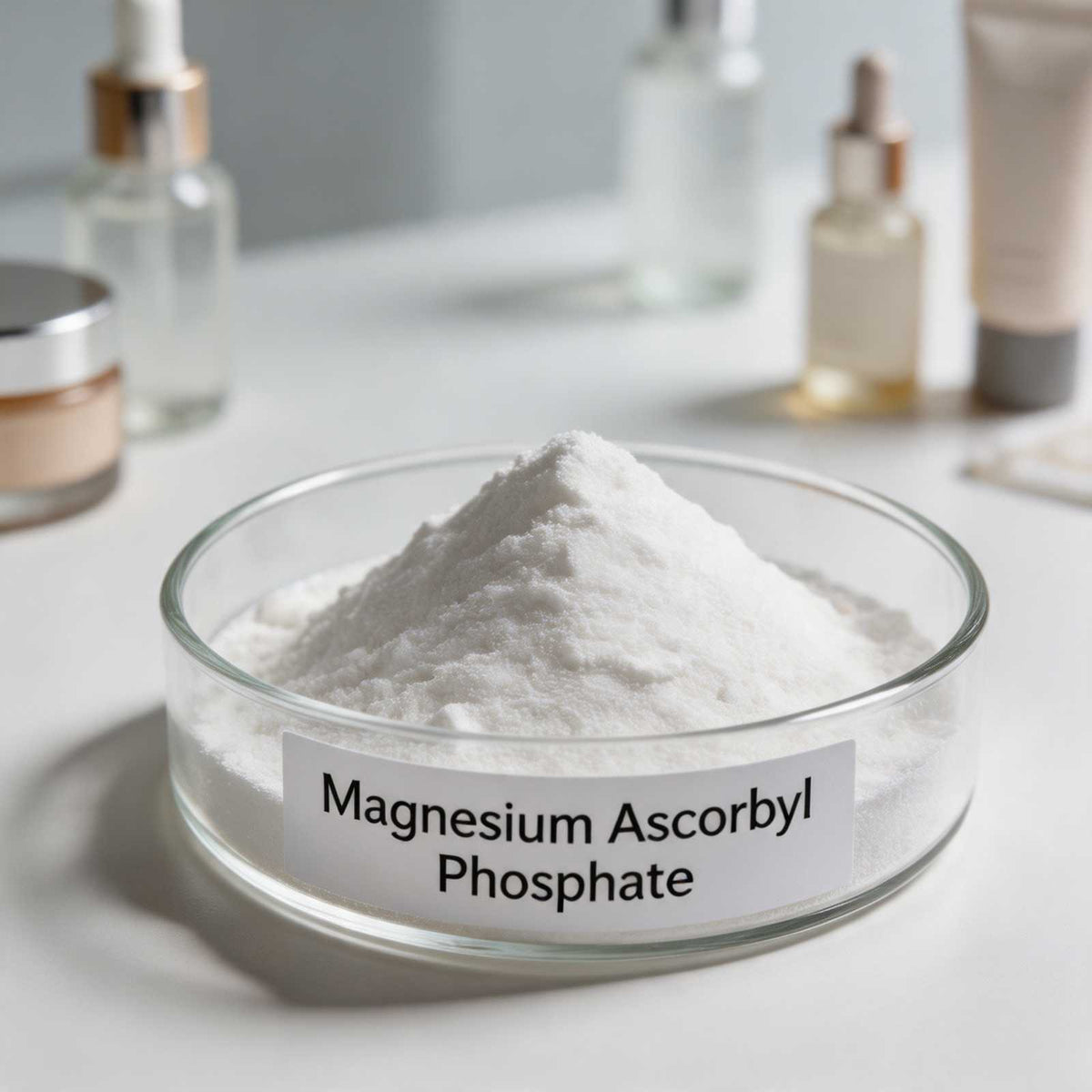
A water-soluble vitamin C derivative for antioxidant, brightening and age-support cosmetic formulations. Magnesium Ascorbyl Phosphate (MAP) is commonly selected when formulators want vitamin C functionality with greater formulation stability than unmodified ascorbic acid.
- Supports brighter, more even-looking skin tone concepts.
- Provides antioxidant support for daily skincare and age-support formulations.
- Water-soluble format fits serums, lotions, creams and other aqueous-phase systems.
- Useful when a more formulation-stable vitamin C derivative is preferred over free ascorbic acid.
- Available in practical small packs for R&D with a bulk-supply path for scale-up.
Product Specifications
|
Property |
Product information |
|
Product name |
Magnesium Ascorbyl Phosphate |
|
INCI |
Magnesium Ascorbyl Phosphate |
|
Commercial form |
White powder |
|
Assay |
≥99% |
|
Ingredient family |
Water-soluble vitamin C derivative |
Key Benefits
Supports brighter, more even-looking skin: MAP is widely used in formulas designed to improve the appearance of dullness and uneven-looking tone. Its vitamin C derivative positioning makes it relevant to brightening serums, lotions and daily tone-care products.Provides antioxidant support: Magnesium Ascorbyl Phosphate functions as an antioxidant in cosmetic use and can support formulas designed to help protect against oxidative stress associated with everyday environmental exposure. [R2]
Fits age-support product concepts: MAP is commonly selected for age-support formulas where antioxidant activity and a smoother, more refined skin appearance are part of the development brief.
Water-soluble and formulation-friendly: Comparable commercial grades are described as water-soluble, making MAP practical for many aqueous phases and water-containing emulsions. [R3–R5]
Why Formulators Choose Magnesium Ascorbyl Phosphate
Unlike free ascorbic acid, MAP is a phosphorylated vitamin C derivative designed for improved stability in cosmetic systems. It gives formulators a practical route to vitamin C positioning without relying on a very low-pH ascorbic-acid system. Its water solubility and near-neutral formulation preference can simplify development for moisturizers, serums and multi-active skincare products.
Typical Applications
Brightening serum / essence---Tone-evening and radiance-focused aqueous formulasCream / lotion---Daily antioxidant and age-support moisturizers
Gel / emulsion serum---Lightweight vitamin C derivative delivery systems
After-sun / environmental-stress care---Antioxidant and comfort-focused formulas
Makeup / hybrid skincare---Color-cosmetic products with skincare positioning
Sensitive-skin concepts---Vitamin C derivative positioning where a low-pH ascorbic-acid system is not desired
Quick Formulation Guide
|
Parameter |
Typical formulation guidance |
|
Use level |
about 0.2–3.0% [R2, R4–R5]. |
|
Solubility / phase |
Water-soluble; pre-dissolve in water and incorporate into the aqueous phase or post-add stage as appropriate for the formula. [R3–R4] |
|
pH direction |
around pH 7–8 or warns of discoloration below about pH 6. [R3–R4] |
|
Temperature / processing |
Avoid unnecessary prolonged heat exposure. [R4] |
|
Compatibility |
Evaluate strong acids, high electrolyte loads, chelating systems, polymers and other oxidation-sensitive actives in the complete formula. |
|
Validation |
Confirm color, clarity, pH, viscosity, preservation, packaging compatibility and accelerated stability before release. |
Why Source From Us
- Start with samples scale to bulk orders – one supplier from trial to production: Validate with lab samples, then scale to commercial volumes – same quality, same team. No re-qualification, no project delays.
- Formulation support that actually helps – not just a data sheet: We give you hands-on guidance on solubility, temperature, pH, and compatibility. A real formulation partner, not a catalog.
- Reliable supply chain – consistent quality, on-time delivery, batch after batch: Own manufacturing facilities plus long-term partnerships with audited upstream producers ensure batch-to-batch consistency. Full documentation with every shipment. No "sample passes, bulk fails"
- Export-ready documentation – compliance, customs, cleared:Complete technical documentation packages – COA, MSDS, TDS, stability data – batch-specific and regulatory-ready. We handle the paperwork so your compliance and procurement teams can focus on formulation
Recommended Ingredient Pairings
|
Recommended Ingredient |
Why It Pairs Well |
Product Concept |
Compatibility Note |
|
Adds complementary lipid-phase antioxidant support |
Antioxidant day cream or lotion |
MAP is water-soluble while tocopherol is oil-soluble; place each in the appropriate phase. |
|
|
Broadens brightening, barrier and tone-care positioning |
Daily brightening serum |
Both favor moderate pH systems, but confirm final pH and complete-formula stability. |
|
|
Adds hydration and skin-feel support |
Hydrating vitamin C serum |
Control polymer hydration order and electrolyte effects on viscosity. |
|
|
Adds humectant and conditioning value |
Sensitive-skin antioxidant lotion |
Validate preservation and final pH in the complete system. |
Research & References
[R1] PubChem — Magnesium Ascorbyl Phosphate, CID 71587428.
[R2] Cosmetic Ingredient Review — Ascorbic Acid and Ascorbates safety review / reaffirmation.
[R3] FUJIFILM Wako — L-Ascorbic Acid Phosphate Magnesium Salt n-Hydrate (AP-MG).
[R4] MakingCosmetics — Vitamin C (Magnesium Ascorbyl Phosphate) Specification Sheet.
Request a Quote
Tell us your required quantity, destination country, and any documentation needs. We usually reply within 1 business day.