

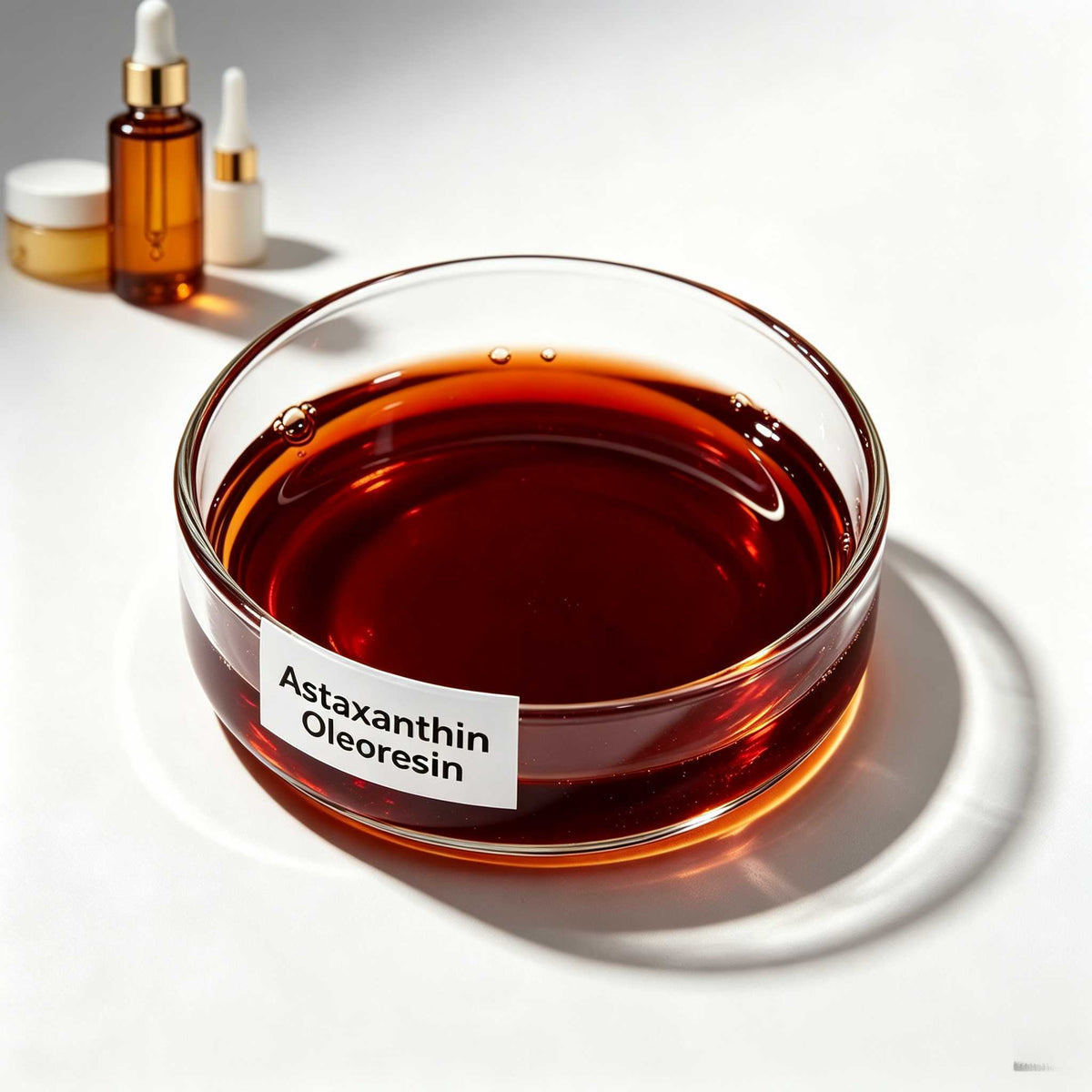
A concentrated oil-soluble astaxanthin raw material for antioxidant-focused skincare, premium age-support formulas and color-rich lipid systems. Astaxanthin is a xanthophyll carotenoid valued in cosmetic research for its antioxidant potential and growing use in skin applications. This 5% oily concentrate gives formulators a practical route to introduce astaxanthin into oils, emulsions, balms and advanced delivery systems without handling a highly concentrated dry carotenoid.
- 5% Astaxanthin active in an oil-based concentrate.
- Supports antioxidant and environmental-stress skincare concepts.
- Useful for radiance, elasticity- and moisture-support product positioning.
- Oil-compatible format for serums, emulsions, balms and lipid delivery systems.
- Strong natural red-orange color can contribute to finished-product appearance.
Product Specifications
|
Property |
Product information |
|
Product name |
Astaxanthin 5% Oleoresin / Oil Concentrate |
|
INCI / active identity |
Astaxanthin |
|
Commercial form |
Oily liquid / oleoresin concentrate |
| CAS | 472-61-7 |
|
Active concentration |
5% Astaxanthin |
|
Parent molecular formula |
C40H52O4 [R1] |
|
Parent molecular weight |
Approx. 596.84 g/mol [R1] |
|
Ingredient family |
Xanthophyll carotenoid / oil-soluble antioxidant |
Key Benefits
Strong antioxidant positioning: Astaxanthin is widely studied as a potent carotenoid antioxidant and is of growing interest in cosmetic systems designed to help defend the appearance of skin exposed to oxidative and environmental stress. [R1–R2]Supports premium age-support formulas: Human and review literature suggest potential benefits for skin moisture, elasticity, texture and overall aging appearance. [R2–R4]
Useful for radiance and photo-stress concepts: Astaxanthin fits formulations positioned around dullness, environmental exposure and visible photo-stress.
Oil-based concentrate simplifies handling: Because Astaxanthin is poorly soluble in water, an oil concentrate can be easier to incorporate into emulsions, lipid serums and balms than a dry carotenoid form. [R1]
Why Formulators Choose Astaxanthin 5% Oil
The 5% concentrate format gives formulators two practical advantages: active-dose flexibility and improved oil-phase handling. Instead of treating astaxanthin as a generic antioxidant powder, the buyer can calculate the desired finished active level from a known 5% concentrate and build the formula around suitable lipids, emulsifiers or delivery systems. Astaxanthin's intense pigment also creates a recognizable premium-active identity.
Typical Applications
- Antioxidant facial oil Oil-soluble premium active for environmental-stress and radiance concepts
- Anti-aging serum / emulsion Low-level astaxanthin delivery in a protected emulsion system
- Barrier / lipid serum Carotenoid antioxidant combined with emollients and barrier lipids
- Eye-area cream Very low active-level evaluation with close color and tolerance control
- After-sun / photo-stress care Cosmetic comfort and antioxidant positioning after environmental exposure
- Balms / anhydrous systems Simple lipid-phase delivery with strong color contribution
Quick Formulation Guide
|
Parameter |
Typical formulation guidance |
|
DOSE (AS SUPPLIED, 5% OLEORESIN) |
General recommended range: 0.15% – 1.0% |
|
Phase |
Oil-soluble — incorporate into the oil phase or add as a pre-dispersion in a carrier oil (e.g., jojoba, squalane, caprylic/capric triglyceride) [R1] |
|
Processing |
Add during cool-down phase at ≤ 40°C [R1–R2] |
|
Color |
Expect strong red-orange coloration even at low active levels; run color and staining evaluation during development. |
| PH | Recommended pH range: 5.0 – 7.0 |
|
Compatibility |
Evaluate with other antioxidants, unsaturated oils, fragrances, UV filters, emulsifiers and packaging because the oxidation environment can affect stability. |
|
Packaging |
Prefer packaging that limits light and oxygen exposure where practical |
Quality Documents & Supply
For commercial qualification, review the current lot specification and confirm the Astaxanthin assay method, carrier oil, source basis, antioxidant/stabilizer system, color/appearance limits, residual solvent and contaminant controls where relevant, packaging, storage conditions and shelf life. Request the current product documents before finalizing a production specification.
Why Source From Us
- Start with samples scale to bulk orders – one supplier from trial to production: Validate with lab samples, then scale to commercial volumes – same quality, same team. No re-qualification, no project delays.
- Formulation support that actually helps – not just a data sheet: We give you hands-on guidance on solubility, temperature, pH, and compatibility. A real formulation partner, not a catalog.
- Reliable supply chain – consistent quality, on-time delivery, batch after batch: Own manufacturing facilities plus long-term partnerships with audited upstream producers ensure batch-to-batch consistency. Full documentation with every shipment. No "sample passes, bulk fails"
- Export-ready documentation – compliance, customs, cleared:Complete technical documentation packages – COA, MSDS, TDS, stability data – batch-specific and regulatory-ready. We handle the paperwork so your compliance and procurement teams can focus on formulation
Recommended Ingredient Pairings
|
Recommended Ingredient |
Why It Pairs Well |
Product Concept |
Compatibility Note |
|
Adds lipid-phase antioxidant support |
Antioxidant facial oil or balm |
Validate oxidation stability and avoid assuming automatic synergy. |
|
|
Provides oxidation-resistant emolliency and easy oil-phase handling |
Premium facial oil / lipid serum |
Check final color and sensory profile. |
|
|
Adds barrier-lipid positioning |
Barrier-support antioxidant cream |
Requires appropriate dispersion/emulsion design. |
|
|
Oil-soluble vitamin C derivative for multi-antioxidant positioning |
Premium antioxidant oil serum |
Validate photostability, oxidation and total active load. |
Research & References
[R1] Lima SGM et al. Astaxanthin Delivery Systems for Skin Application: A Review. Marine Drugs. 2021.
[R3] Systematic Review and Meta-Analysis on the Effects of Astaxanthin on Human Skin Ageing. 2021.
[R4] Tominaga K et al. Cosmetic benefits of astaxanthin on human subjects. Acta Biochim Pol. 2012.
Request a Quote
Tell us your required quantity, destination country, and any documentation needs. We usually reply within 1 business day.