

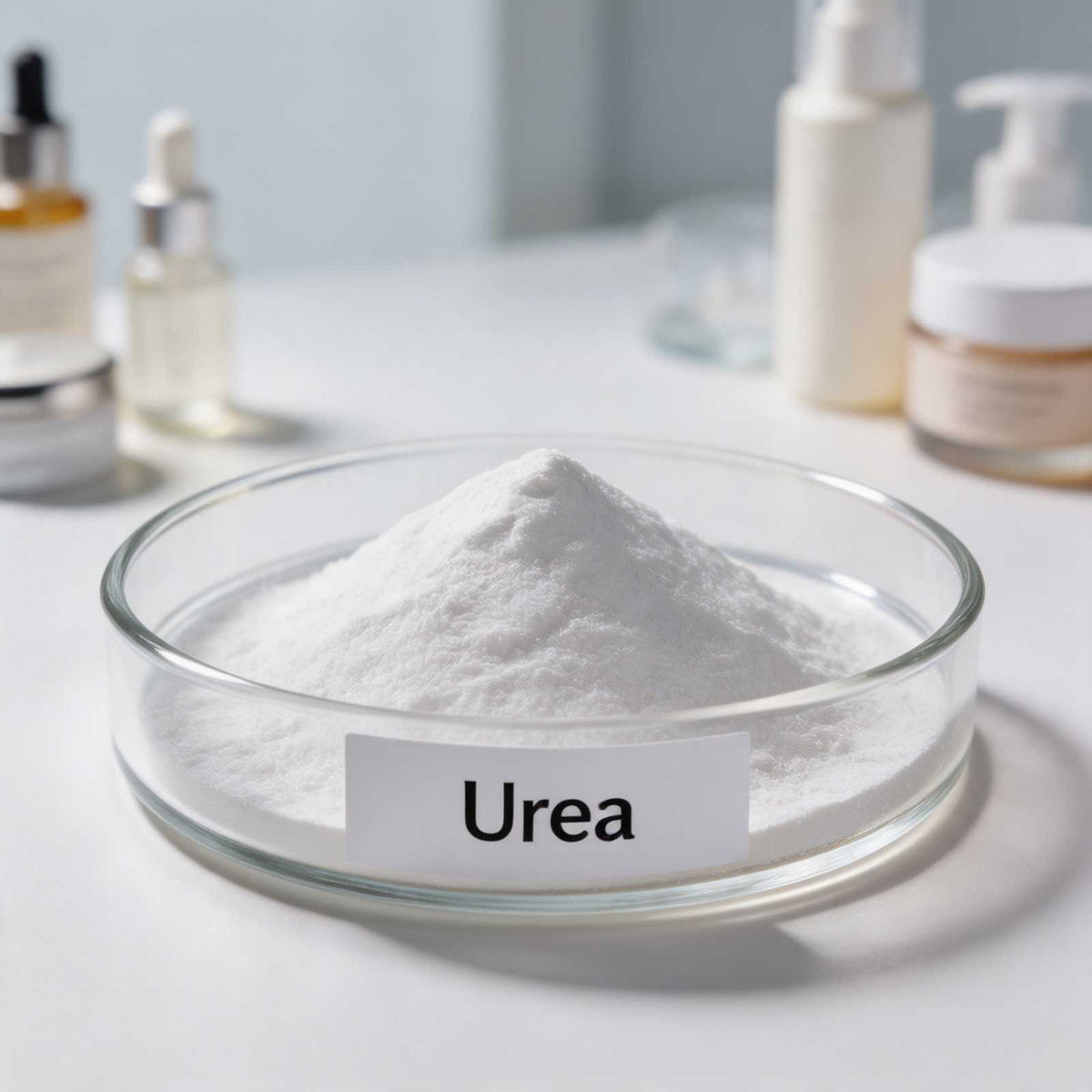
A high-purity, water-soluble humectant for moisturizing, dry-skin and conditioning cosmetic formulations. This 99% white urea powder gives formulators a concentrated raw material for creams, lotions, serums, cleansers and hair-care products where hydration, skin feel and controlled higher-use-level exfoliation concepts are important.
- 99% white powder for measured cosmetic formulation.
- Supports hydration and moisture-retention positioning in skin-care formulas.
- Useful in dry, rough-skin and conditioning concepts; higher levels can provide stronger keratolytic functionality.
- Paid small-pack evaluation and bulk-supply pathways support trial-to-scale purchasing.
Product Specifications / Key Facts
|
Property |
Product Information |
|
Product name |
Urea |
|
Commercial form |
White powder |
|
Purity / assay |
99% |
|
INCI |
Urea |
|
CAS Number |
57-13-6 |
|
Molecular Formula |
CH4N2O |
|
Molecular Weight |
60.056 g/mol |
|
Ingredient family |
Humectant / skin-conditioning ingredient |
Key Benefits
Supports skin hydration — Urea is widely used as a humectant in cosmetic formulations designed to attract and retain water and improve the feel of dry skin.
Helps improve rough, dry skin feel — In appropriately designed formulas, urea supports softer, smoother-looking skin and is commonly selected for dry-skin and body-care products.
Useful across concentration-dependent product concepts — Lower levels are commonly used for moisturization, while higher cosmetic-use levels can contribute more noticeable keratolytic / scale-softening functionality.
Water-soluble and formulation-friendly — Its strong water solubility makes urea practical for incorporation into the aqueous phase of many creams, lotions, serums and cleansers.
Why Formulators Choose Urea
Urea is a compact, highly water-soluble ingredient that fits both straightforward moisturizing formulas and more intensive dry-skin concepts. It can deliver humectancy at modest use levels while allowing formulators to build stronger smoothing / keratolytic positioning at higher levels. Because urea stability can be affected by processing conditions and final formula environment, disciplined temperature, pH and long-term stability testing are important in development.
Typical Applications
- Moisturizing creams and lotions
- Dry-skin and rough-texture body care
- Hand and foot care
- Hydrating serums and toners
- Cleansers and body washes
- Scalp and hair-conditioning products
Quick Formulation Guide
|
Parameter |
Typical Formulation Guidance |
|
Use level |
2–15% as a typical range for emulsions. [R3] |
|
Solubility / phase |
Highly soluble in water; typically incorporated into the aqueous phase. [R3] |
|
Processing |
Use controlled processing conditions and avoid unnecessary prolonged heat exposure. Confirm stability, odor and pH after processing and during accelerated testing. |
|
pH / stability |
Urea can be sensitive to unfavorable formulation conditions over time. Maintain a suitable finished-formula pH for the overall system and verify long-term pH / odor stability rather than relying on one generic limit. |
|
Compatibility |
Usually compatible with common humectants and water-phase ingredients, but high electrolyte load or concentrated urea can change viscosity, sensory profile and preservative performance. |
|
Storage / handling |
Keep the raw powder tightly closed and dry. Protect from contamination and excessive heat; follow the current SDS / specification for the selected grade. |
Why Source From Us
- Start with samples scale to bulk orders – one supplier from trial to production: Validate with lab samples, then scale to commercial volumes – same quality, same team. No re-qualification, no project delays.
- Formulation support that actually helps – not just a data sheet: We give you hands-on guidance on solubility, temperature, pH, and compatibility. A real formulation partner, not a catalog.
- Reliable supply chain – consistent quality, on-time delivery, batch after batch: Own manufacturing facilities plus long-term partnerships with audited upstream producers ensure batch-to-batch consistency. Full documentation with every shipment. No "sample passes, bulk fails"
- Export-ready documentation – compliance, customs, cleared:Complete technical documentation packages – COA, MSDS, TDS, stability data – batch-specific and regulatory-ready. We handle the paperwork so your compliance and procurement teams can focus on formulation
Recommended Ingredient Pairings
|
Recommended Ingredient |
Why It Pairs Well |
Product Concept |
Compatibility Note |
|
Glycerin |
Adds complementary humectancy and helps build a familiar hydration system. |
Daily moisturizing lotion |
Validate tack, sensory profile and preservative system at the total humectant load. |
|
Adds water-binding and skin-feel support for hydration-focused formulas. |
Hydrating serum / lotion |
High dissolved-solids levels may affect polymer viscosity; test the selected HA grade. |
|
|
Supports conditioning and comfort positioning in dry-skin or scalp-care products. |
Barrier-support cream / scalp lotion |
Check final pH and long-term stability. |
|
|
Lactic Acid |
Can support moisturization and pH adjustment in selected dry-skin concepts. |
Body lotion / rough-texture care |
Acidic systems change urea stability and product behavior; validate pH, odor and stability carefully. |
Research & References
[R2] Cosmetic Ingredient Review — Urea ingredient page; most recent panel meeting June 2026.
Request a Quote
Tell us your required quantity, destination country, and any documentation needs. We usually reply within 1 business day.