

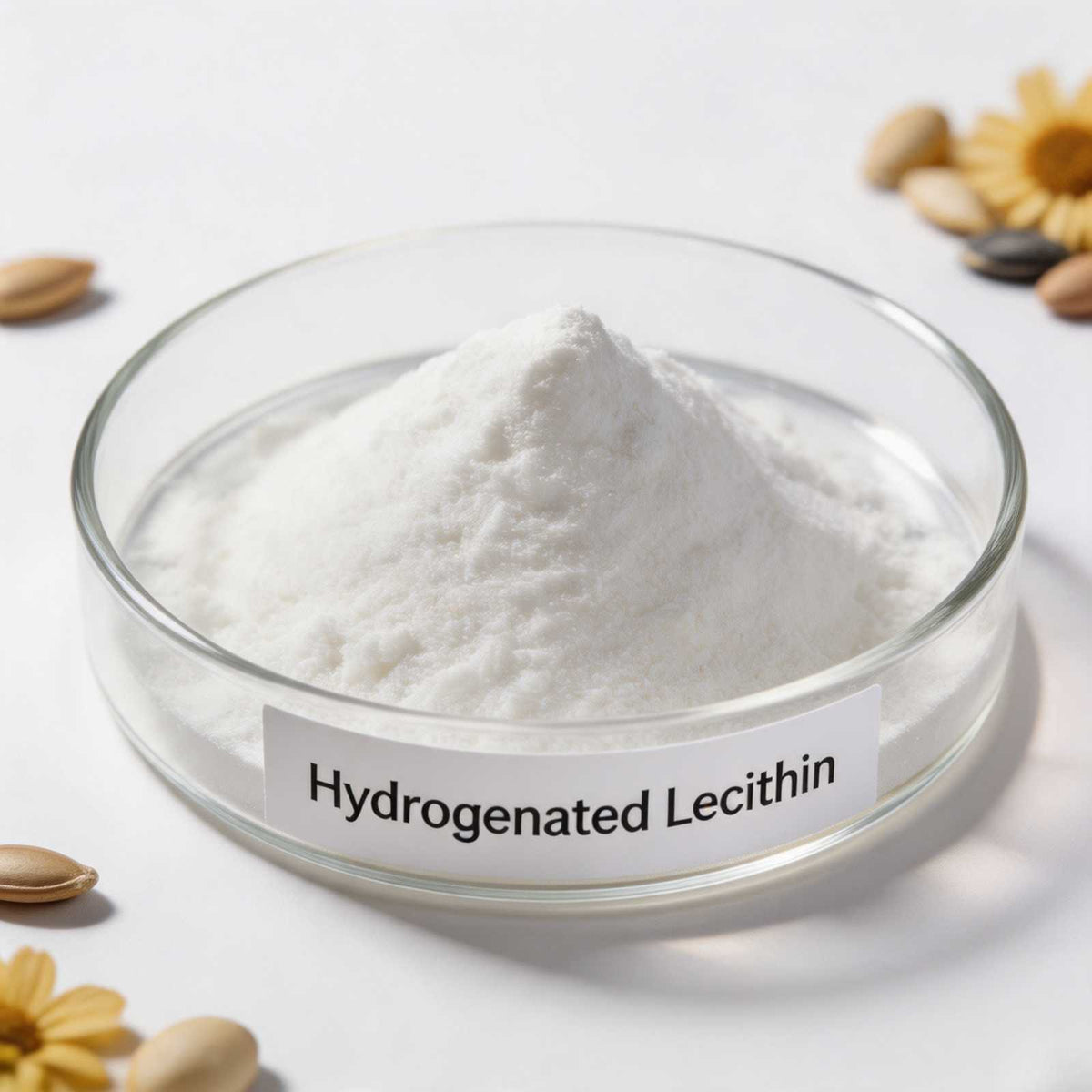
- Helps build stable, well-structured cosmetic emulsions. [R1,R3–R6]
- Supports lamellar and liposome-oriented systems when the complete formula is designed for self-assembly. [R1,R4–R8]
- Useful in creams where smooth skin feel and barrier-supportive formulation are priorities. [R4–R5,R8]
- Pack sizes: 10 g / 25 g / 100 g / 500 g / 1 kg, with larger quantities by bulk quote.
FROM TRIAL SIZE TO BULK
Choose a Development Size for formulation work, request current product information, or send your quantity, destination and specification needs for a Bulk Quote.
Product Specifications / Key Facts
|
Item |
Information |
|
INCI name |
Hydrogenated Lecithin [R1–R3] |
|
CAS Number |
92128-87-5 [R1–R3] |
|
Commercial form |
White powder |
|
Commercial content / assay |
98% |
|
Ingredient family |
Hydrogenated phospholipid mixture / cosmetic emulsifier |
|
Primary cosmetic functions |
Emulsifying, skin conditioning and dispersing [R1] |
|
Formulation behavior |
Amphiphilic phospholipid material; can support lamellar and liposome-oriented systems depending on grade and formula [R1,R4–R8] |
|
Intended use |
Raw material for cosmetic formulation and product development; not a finished cosmetic |
Key Benefits
Why Formulators Choose Hydrogenated Lecithin Powder
- Hydrogenation improves heat and oxidation resistance versus conventional lecithin, supporting more stable structured systems. [R3–R4]
- Comparable cosmetic grades are often screened at 1–5%. [R5–R6]
- Phosphatidylcholine content can change emulsification behavior and lamellar or liposomal structure. [R3,R5,R8]
- Powder format gives R&D teams direct control over the emulsifier system.
Typical Applications
- Barrier-support and ceramide-focused creams
- Moisturizers, lotions and gel-creams
- Lamellar / liquid-crystal emulsion systems
- Liposome-oriented serums and active-delivery development
- Eye creams, masks and premium skin-care emulsions
Quick Formulation Guide
|
Decision Point |
Practical Buyer Guidance |
|
Typical use level |
As sole emulsifier: 3% |
|
Phase / dispersion |
Pre-disperse in oil phase or water phase before adding to bulk — powder does not dissolve directly in water at room temperature [R1,R3,R7–R8] |
|
Processing |
Heat oil or water phase to 70°C – 80°C, then add powder and stir for ~20 min |
|
pH |
Recommended finished formula pH: 5.0 – 7.0 |
|
Compatibility |
Screen the oil phase, co-emulsifiers, thickeners, electrolytes and active load; these can change structure and viscosity. [R5] |
|
Storage / handling |
Keep tightly sealed and dry. |
Why Source From Us
- Start with samples scale to bulk orders – one supplier from trial to production: Validate with lab samples, then scale to commercial volumes – same quality, same team. No re-qualification, no project delays.
- Formulation support that actually helps – not just a data sheet: We give you hands-on guidance on solubility, temperature, pH, and compatibility. A real formulation partner, not a catalog.
- Reliable supply chain – consistent quality, on-time delivery, batch after batch: Own manufacturing facilities plus long-term partnerships with audited upstream producers ensure batch-to-batch consistency. Full documentation with every shipment. No "sample passes, bulk fails"
- Export-ready documentation – compliance, customs, cleared:Complete technical documentation packages – COA, MSDS, TDS, stability data – batch-specific and regulatory-ready. We handle the paperwork so your compliance and procurement teams can focus on formulation
Recommended Ingredient Pairings
|
Recommended Ingredient |
Why It Pairs Well |
Product Concept |
Compatibility Note |
|
Adds a skin-lipid component that complements phospholipid-based barrier systems. |
Barrier cream or lotion |
Confirm ceramide dispersion, oil-phase design and final structure. |
|
|
Adds a companion lipid for barrier-focused formulas. |
Biomimetic barrier cream |
Balance with the lipid/emulsifier system; test crystallization and texture. |
|
|
Adds a light emollient phase and smooth skin feel. |
Lightweight moisturizer |
Screen oil-phase ratio and emulsifier level. |
|
|
Adds water-phase hydration support alongside the emulsifier system. |
Barrier + hydration moisturizer |
Confirm hydration order, pH and preservation. |
|
|
Adds conditioning and comfort for skin or scalp formulas. |
Soothing moisturizer or scalp emulsion |
Validate pH, viscosity and preservation. |
Scientific Evidence Snapshot
CIR lists Hydrogenated Lecithin as a cosmetic phosphoglyceride used for emulsifying and skin conditioning, and concluded the reviewed phosphoglycerides are safe in the assessed practices of use and concentration. [R1]
A 2023 finished-formula study using a specific Hydrogenated Lecithin grade with Tween 80 formed liquid-crystalline structures and improved hydration and TEWL measurements. The result applies to that tested cream system. [R5]
Research & References
[R1] Cosmetic Ingredient Review — Safety Assessment of Lecithin and Other Phosphoglycerides
[R3] NIKKOL GROUP — NIKKOL LECINOL S-10M
[R4] Lipoid Kosmetik — Phospholipids as Functionals
[R5] Teeranachaideekul et al. (2023) — Liquid Crystalline Emulsions
[R6] Uniproma — Smartsurfa-HLC(30%) / Hydrogenated Lecithin
[R7] Strati et al. (2025) — Hydrogenated Plant-Based Lecithins as Excipients
Request a Quote
Tell us your required quantity, destination country, and any documentation needs. We usually reply within 1 business day.